A lot of people search how long does a dental crown procedure take when they are already dealing with a cracked tooth, a broken filling, or pain when they chew. They are not just asking about time. They are asking how many appointments they will need, whether it will hurt, and how disruptive it will be to work, school, or family life.
If that is where you are right now, the good news is that the answer is usually clear once your tooth is examined. Some crowns still follow a traditional two-visit process over a couple of weeks. Others can be completed in one appointment with same-day technology. The right choice depends on your tooth, your goals, and how much you want to avoid wearing a temporary crown.
Your Guide to Dental Crowns in Vienna
A common situation goes like this. You bite on something hard, feel a sharp crack, and spend the rest of the day wondering whether the tooth can be saved. Then the next question shows up fast: how long is this going to take?
That concern is completely reasonable. A crown is one of the most reliable ways to restore a tooth that is cracked, heavily filled, worn down, or weakened after treatment. But the timeline can feel confusing because patients hear different answers from different offices.

Dr. Vikram Chauhan approaches this conversation the way patients usually need it explained. Clearly, calmly, and without jargon. If you have been reading about the dental crown procedure, it helps to know that the process has a few core steps no matter which type of crown you choose.
What a crown does
A dental crown is a custom cap that covers a damaged tooth. Its job is to protect the tooth, restore chewing strength, and help the tooth look natural in your smile.
Some patients need a crown after a cavity becomes too large for a filling. Others need one after a root canal, after a fracture, or to restore a dental implant. The reason matters because it can affect the timeline.
Why the timeline feels different from patient to patient
Two people can both need crowns and have very different experiences.
One patient may need a straightforward restoration on a front tooth with healthy surrounding tissue. Another may have deep decay, an old failing filling, or a back molar that takes more time to shape and restore properly.
Key takeaway: The time for a crown is not just about the crown itself. It also depends on the condition of the tooth underneath it.
That is why the most useful answer starts with an exam. Once the tooth is evaluated, the timeline usually becomes much easier to predict.
The First Step Your Initial Crown Appointment
You come in expecting the crown itself to be the main event. For many patients, the first appointment is the part that answers the biggest questions and sets the tone for everything that follows.

At this visit, Dr. Chauhan checks what is happening with the tooth, explains what can be saved, and helps you understand whether you are looking at a traditional lab-made crown or a same-day digital option. That distinction matters more than many patients expect, because it can determine whether you leave with a short-term temporary crown or a finished restoration.
Exam and planning
The appointment starts with a close look at the tooth, your bite, and the surrounding gum tissue. If there is a crack, deep decay, or an older filling breaking down, that changes how the tooth needs to be rebuilt before a crown can do its job.
A crown works like a helmet over a tooth, but the helmet only protects well if the structure underneath is sound. If the foundation is weak, the crown can feel off, loosen sooner, or fail to protect the tooth the way you need it to.
Gentle tooth preparation
Next, the tooth is shaped so the crown can fit with the right thickness and contour. Patients often hear "shaping" and worry that too much tooth will be removed. The goal is careful, measured reduction, not aggressive drilling.
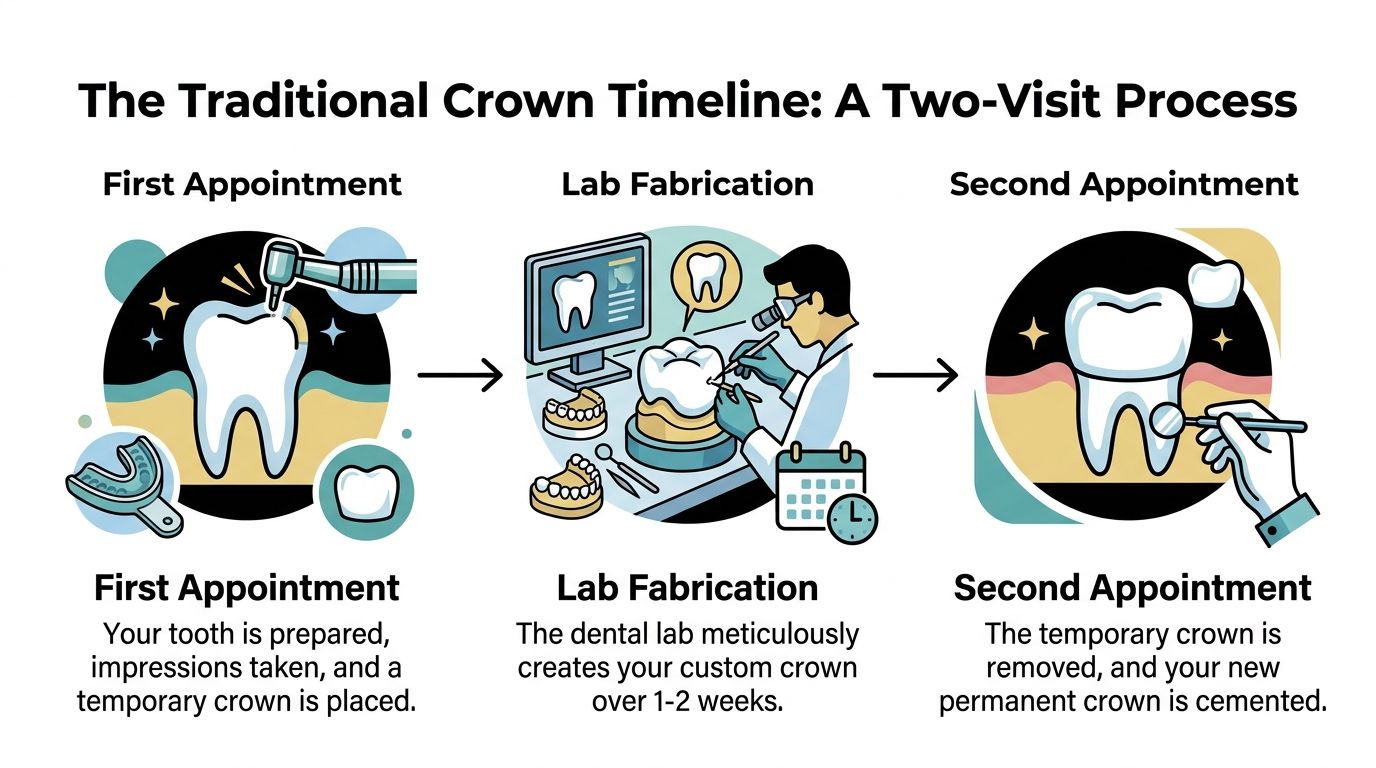
For a traditional crown, this first appointment usually takes the most time because it includes the exam, preparation, and the records needed for the lab-made restoration. Traditional crown procedures typically require two appointments over about two weeks, with the first visit lasting 60 to 90 minutes and the lab taking 3 to 14 days to fabricate the custom crown, according to this overview of crown timing https://cdavirginia.com/how-long-does-it-take-to-place-a-dental-crown-on-a-tooth/.
Records for the final crown
Once the tooth is prepared, the office captures the details for the final crown. That may mean digital scans or impressions, depending on the workflow.
Patients are often surprised by a few parts of this stage:
- The first visit does most of the technical work. This is when the tooth is evaluated, shaped, and recorded for the final restoration.
- A traditional case may involve a temporary crown. That temporary protects the tooth, but it can also create a period of uncertainty for patients who worry about it coming loose, feeling bulky, or limiting what they can eat.
- Anxiety can be planned for. If you are nervous, your dental team can slow the pace, explain each step, and discuss comfort options before treatment starts.
Why this appointment matters so much
This visit is where the plan becomes clear. You learn whether the tooth can be restored in one day or whether you will spend time wearing a temporary crown while the permanent one is made.
That waiting period is often the hidden source of stress. Some patients do fine with a temporary. Others spend days babying the tooth, avoiding sticky foods, and wondering whether the temporary will hold up until the next visit. At our Vienna, VA office, that is one reason same-day CEREC crowns can feel so reassuring. They remove the gap between preparation and placement, which means fewer unknowns and less time spent protecting a short-term solution.
Tip: If you are planning around work, school pickup, or family schedules, expect the first crown appointment to take longer than the final seating visit in a traditional case.
The Traditional Crown Timeline A Two-Visit Process
A traditional crown often feels straightforward on paper. You come in once to prepare the tooth, then return after the lab finishes the final crown. For many patients, the harder part is not the dentistry itself. It is the stretch in between, when you are relying on a temporary crown and trying not to disturb it.
What happens at visit one
At the first appointment, the tooth is shaped so the final crown can fit securely. We also take impressions or digital records and send that information to a dental lab, where your permanent crown is made.
Before you leave, a temporary crown is placed over the prepared tooth. It works like a protective cover while the lab completes the custom restoration. It lets you chew carefully, helps limit sensitivity, and keeps the tooth from shifting out of position.
The waiting period
With the traditional approach, treatment is split into two visits because the permanent crown is made outside the office. The exact timing varies by lab schedule, case complexity, and whether any bite or shade details need extra attention.
That delay is not unusual. It is built into the process.
For some patients, that waiting period passes without much trouble. For others, it is the part they remember most. A temporary crown can feel a little bulky. You may need to avoid sticky foods, chew more carefully on one side, or call the office if it loosens. That is one reason many people ask about same-day crown treatment in a single visit once they understand the traditional timeline.
What happens at visit two
At the second appointment, the temporary crown is removed and the final crown is tried in. The dentist checks the fit, contacts between teeth, color, and bite before cementing it into place.
If the crown seats well and your bite feels right, this visit is usually shorter than the first one. If a small adjustment is needed, we make it before the crown is permanently bonded.
The trade-offs patients should know
Traditional crowns are well established and can still be the right choice in some cases. But they come with more moving parts. There is the lab turnaround, the temporary material, and the chance that a crown may need adjustment or, in some cases, remaking after it returns from the lab.
The temporary period is where anxiety tends to build. Patients often worry about eating, appearance, tenderness, or what happens if the temporary comes off before the second visit. Temporary crowns can also allow microleakage if they do not seal perfectly, which is one reason dentists prefer not to leave them in place longer than necessary. Research on provisional crowns has examined concerns such as marginal leakage and bacterial penetration at the temporary crown margin, including in this PubMed-indexed review on microleakage in provisional crowns.
Why temporary crowns make people nervous
Patients usually ask practical questions during those days or weeks between visits:
| Concern | Why it matters |
|---|---|
| Eating normally | Sticky or hard foods can dislodge a temporary crown |
| Sensitivity | A prepared tooth may feel more reactive under a temporary |
| Appearance | Temporary materials may not match the final look and feel |
| Scheduling | If the temporary loosens or breaks, you may need an extra appointment |
For a patient with a busy workweek, family responsibilities, or dental anxiety, that extra layer of uncertainty can feel like carrying around a fragile placeholder. That is the hidden downside of the two-visit model. The crown is on hold, and your peace of mind often is too.
The Modern Alternative Same-Day CEREC Crowns
Same-day crowns change the question from “How many visits will this take?” to “Can we finish this today?” In many cases, the answer is yes.

How the same-day process works
After the tooth is prepared, the dentist captures a digital scan instead of sending impressions to an outside lab. The crown is then designed on-screen and milled in the office from a ceramic block.
That means there is no separate lab turnaround. There is also no temporary crown period between visits because the permanent restoration is made during the same appointment.
Same-day CEREC crown procedures average 90 minutes to 2.5 hours in one visit, with digital scanning and design taking 15 to 30 minutes, in-office milling taking 15 to 30 minutes, and final cementation completing the process. This approach has also been reported with 97% patient satisfaction and 98% fit accuracy in this review of same-day crown timing.
Why many patients prefer this route
The appeal is not just speed. It is simplicity.
A same-day crown can reduce the number of moving parts in treatment:
- One appointment instead of two. That is easier to fit into a busy week.
- No temporary crown to baby. You do not spend the next couple of weeks worrying about what you can chew.
- No lab delay. The restoration is created in-office during your visit.
- Digital design. Many patients like seeing the process and understanding how the crown is shaped.
If you want to learn more about the workflow, this overview of same-day crowns in a single visit gives a practical look at what patients can expect.
Where this matters most
The hidden advantage of same-day treatment is peace of mind.
A patient with an important event coming up, a family schedule that is already overloaded, or a strong dislike of temporary crowns may care less about the technology itself and more about what the technology avoids. No return trip. No temporary coming loose at dinner. No stretch of days spent protecting a prepared tooth.
Practical takeaway: If the main thing stressing you out is the waiting period, same-day crowns directly address that concern.
That does not mean every case should be handled the same way. It means the modern option exists, and for many patients it is the cleaner, calmer path.
Factors That Influence Your Procedure Time
A crown appointment is a bit like repairing a house before putting on a new roof. If the structure underneath is solid, the job moves along smoothly. If there is hidden damage, the repair takes longer because the foundation has to be made stable first.
That is why two patients can both need crowns and still have very different appointment lengths.
The condition and location of the tooth
Some teeth are simple to prepare. Others need careful rebuilding first.
If a tooth has deep decay, a large old filling, or a crack that has weakened the remaining walls, your dentist may need extra time to remove damage and create a strong base for the crown. Front teeth and molars can also present different challenges. A back molar often takes more time because access is tighter and the crown has to be shaped to handle stronger biting forces.
Whether the tooth needs support before the crown
A crown is often the final layer of protection, but some teeth need help before they are ready for that final step.
For example, a tooth may need a core build-up after a large filling, or it may need root canal treatment first if the nerve is infected. In those cases, the total timeline becomes longer because we are not just placing a crown. We are first making sure the tooth is healthy enough to keep.
Your comfort level matters too
Time in the chair is not only about the tooth. It is also about how the visit feels to you.
Some patients are happy to move through treatment without stopping. Others do better with short breaks, a slower pace, or sedation support because anxiety makes a longer visit feel overwhelming. That is a normal part of treatment planning, not a complication. At our Vienna office, we factor that in from the start so the visit feels manageable, not rushed.
The waiting period can create its own problems
This is the part many patients do not realize until they have lived through it.
With a traditional crown, the prepared tooth is often protected by a temporary while the final crown is being made. During that waiting period, patients may deal with sensitivity, food getting around the temporary, chewing limitations, or the worry that it could loosen at an inconvenient time. If you want to know what helps after placement, our guide on how to care for dental crowns after treatment walks through the basics.
That extra layer of uncertainty is one reason some patients strongly prefer same-day treatment. It removes the stretch of days or weeks where you are trying to protect a temporary crown and hoping nothing goes wrong before the final visit. The American Dental Association also notes that a temporary crown is used to protect the tooth between visits in the traditional process, which helps explain why the waiting period can feel like the hardest part for anxious patients (ADA overview of crowns).
Questions that help predict your timeline
A few details usually tell us a lot about how long your procedure may take:
- Is the tooth mildly damaged or heavily broken down?
- Is it a front tooth or a hard-to-reach molar?
- Do you need a build-up or root canal before the crown?
- Would a temporary crown period add stress to your routine?
- Would breaks or sedation make the visit easier for you?
A realistic estimate is always better than a vague promise. Once Dr. Chauhan examines the tooth, we can explain what is adding time, what is straightforward, and whether a same-day CEREC crown may help you avoid the part of the process that causes the most worry.
Your Crown Experience at Vienna Implant and Family Dentistry
Patients usually want two things at the same time. They want the crown done correctly, and they want the process to feel manageable.
That is where treatment planning matters. Some patients are better served by a traditional lab-made crown. Others are strong candidates for a same-day digital crown. The right choice depends on the tooth, the bite, appearance goals, and whether avoiding a temporary crown matters in daily life.
What personalized care looks like
At Vienna Implant and Family Dentistry, Dr. Chauhan evaluates the condition of the tooth first, then recommends the workflow that fits the case. That may include a same-day CEREC crown, a traditional crown, implant-supported restoration, or a broader restorative plan if several teeth are involved.
Patients who feel nervous often appreciate that comfort can be built into the visit. A calm pace, clear explanations, and sedation options can make a major difference, especially for anyone who has put off care because they feared a long appointment.
The details patients usually remember
People often remember the small things more than the technical ones:
- Clear communication about how long the visit is likely to take
- A family-friendly setting that does not feel rushed
- Modern technology that can reduce messy impressions
- Practical guidance after treatment, including how to protect and maintain the new crown
For patients who already have crowns or are preparing for one, this guide on how to care for dental crowns can help answer the common next-step questions.
When patients understand the process, they usually feel more in control. That alone can make the appointment feel easier.
Schedule Your Consultation in Vienna Today
The short answer to how long does a dental crown procedure take is this. It can take a few hours in a single visit, or it can take a couple of weeks across two appointments. The right timeline depends on the tooth and the type of crown being used.
For many people, the biggest issue is not the crown itself. It is the waiting period, the temporary crown, and the uncertainty in between. If that sounds familiar, it helps to talk through your options before the tooth becomes more uncomfortable.
If you live in Vienna, VA or nearby Northern Virginia communities and want a clear answer for your specific case, schedule a consultation with Dr. Chauhan. A simple exam can tell you whether your tooth is a candidate for a traditional crown or a same-day solution, and what the process would realistically look like for your schedule and comfort.