You've finally achieved the beautiful, confident smile you've always wanted with your new veneers. To keep that smile looking its best, the secret lies in choosing the right toothpaste. The best toothpaste for veneers is a gentle, non-abrasive, non-whitening formula, preferably one that contains fluoride. This simple choice is your best defense against scratching, ensuring your new smile stays brilliant for years to come here in Vienna, VA.
Protecting Your Investment in a Perfect Smile
After getting your new porcelain veneers at our Vienna, VA office, you leave with a smile that lights up the room. Of course, you want to keep it that way. The most common question we hear from our patients is, "What kind of toothpaste should I use now?" It’s a great question, because the wrong toothpaste can slowly dull the beautiful luster of your veneers or even cause permanent damage.
Here at Vienna Dental Implant & Family Dentistry, our team is committed to giving our community in Vienna and surrounding areas clear, practical advice for maintaining fantastic oral health. Your new veneers are incredibly strong and durable, but they aren’t invincible. Unlike natural tooth enamel, the highly polished surface of a porcelain veneer can't heal or repair itself from scratches.

Why Your Toothpaste Choice Matters
Think of it this way: you wouldn't wash a brand-new car with sandpaper. You’d use a soft cloth to protect the paint's glossy finish. The same principle applies to your veneers. Many popular toothpastes, especially whitening or deep-cleaning formulas, contain abrasive particles that are simply too harsh for cosmetic dental work.
Here’s what you need to keep in mind when caring for your smile:
- Avoid Abrasives: Gritty ingredients found in many toothpastes can create microscopic scratches on the veneer surface, eventually making them look dull and prone to staining.
- Protect the Bond: The seal where the edge of the veneer meets your natural tooth is a critical area. Using gentle products helps protect this margin from being damaged, which also prevents decay from sneaking in underneath.
- Maintain Luster: The goal is to gently lift away surface stains from coffee, tea, or food without etching or scratching the porcelain. This is key to keeping your smile as vibrant as it was on day one.
The most effective oral care routine for veneers combines the right products with the right technique. A low-abrasion toothpaste is your first line of defense in preserving their flawless finish.
Led by Dr. Vikram Chauhan, our team at Vienna Dental Implant & Family Dentistry is here to guide you through every aspect of your cosmetic dentistry journey, from the initial procedure to long-term care. This guide will walk you through exactly what to look for—and what to avoid—on your next trip to the pharmacy, empowering you to protect your brilliant new smile with total confidence.
Understanding Why Veneers Need Special Care
To pick the right toothpaste for your veneers, it really helps to first understand what they are and why they’re so different from your natural teeth. Veneers are a popular cosmetic dentistry solution that provides a long-lasting, beautiful smile. Think of a veneer as a custom-fit, high-end contact lens for your tooth. It’s beautifully crafted and surprisingly durable, but it’s not indestructible. This single distinction is the key to taking care of them for the long haul.
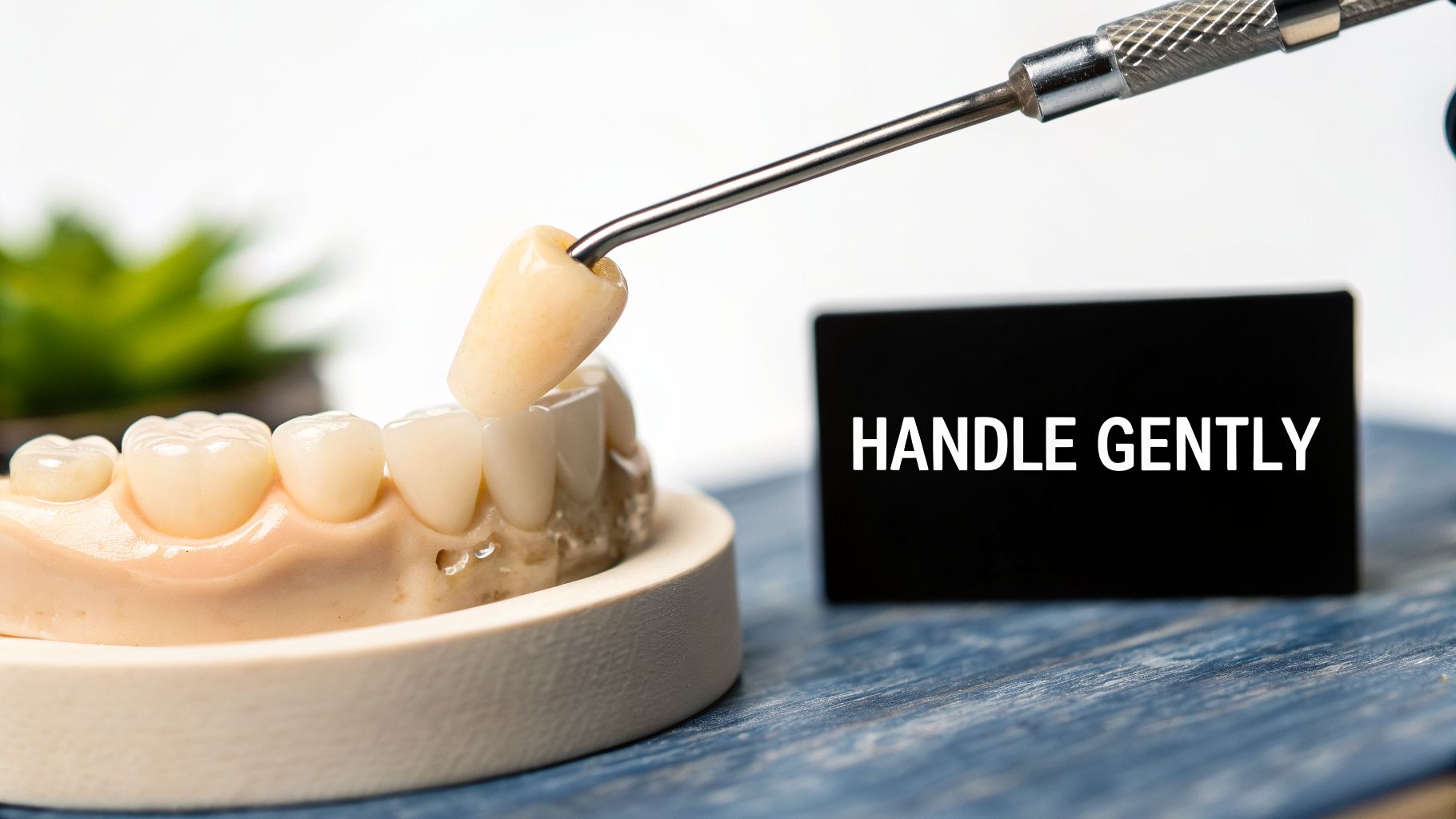
Whether your veneers are made from delicate porcelain or resilient composite resin, their surfaces have been meticulously polished to a glass-like finish. This is exactly what gives them that lifelike luster and impressive stain resistance. But here’s the crucial part: unlike your natural tooth enamel, these materials can’t heal or repair themselves from damage.
Why Porcelain And Composite Differ From Enamel
Your natural tooth enamel is the hardest substance in your entire body, but it’s also porous. It has the amazing ability to remineralize with help from fluoride, essentially healing itself from minor acid attacks from food and drink. Veneers, on the other hand, are non-porous and static. If an abrasive toothpaste scratches their surface, that damage is permanent.
Those microscopic scratches act like velcro for stain particles, dulling your veneer’s shine and even attracting new discoloration. This slowly defeats the whole purpose of your cosmetic investment. That’s why gentle care is so critical. A harsh, gritty toothpaste will, slowly but surely, wear away that polished finish, making your beautiful veneers look worn and lackluster. You can dive deeper into these material differences in our guide on composite versus porcelain veneers.
Protecting The Delicate Bond And Underlying Tooth
There’s another crucial piece to the puzzle: protecting the bond. Each veneer is secured to your natural tooth with a powerful dental adhesive. This process creates a tiny, almost invisible seam or margin where the edge of the veneer meets your tooth, typically right at the gumline.
The integrity of the bond at the veneer's margin is critical for both its longevity and the health of the underlying tooth. Protecting this seal from harsh chemicals and abrasive forces is a top priority.
This margin is the most vulnerable spot on the entire restoration. If that bonding agent is weakened by aggressive brushing or harsh ingredients, or if plaque is allowed to build up along this line, it can cause two major problems:
- Staining: The seam itself can pick up stains, creating a noticeable, dark line that detracts from your otherwise perfect smile.
- Decay: Worse, bacteria can sneak their way under the edge of the veneer and cause a cavity in the natural tooth structure hiding beneath.
Because your natural tooth is still very much alive and susceptible to decay under that veneer, using a fluoride toothpaste is non-negotiable. Fluoride strengthens the exposed parts of your tooth and helps shield those vulnerable margins from decay. Armed with this foundational knowledge, you can make smarter choices to ensure your smile stays healthy and brilliant for years to come.
How to Decode Toothpaste Labels for Veneer Safety
Walking down the toothpaste aisle can feel like a high-stakes exam, especially when your new veneers are on the line. With so many options promising whitening, deep cleaning, and more, it’s easy to feel overwhelmed. The good news is, you don’t need to be a chemist to make the right choice.
Learning how to read a toothpaste label is the single most important skill you can develop to protect your investment and keep your new smile looking brilliant for years to come. It all comes down to understanding a few key terms.
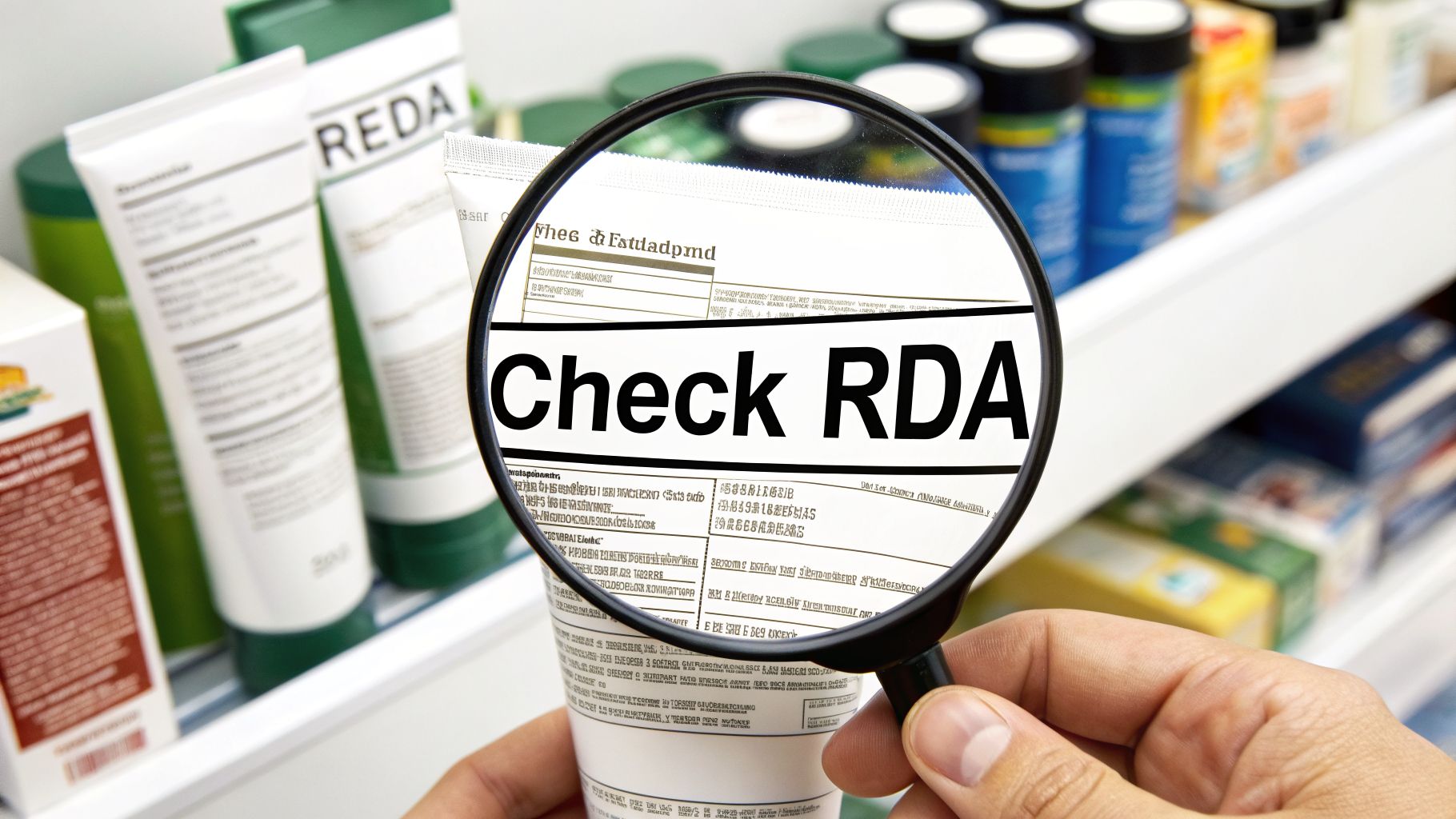
The first and most critical concept is Relative Dentin Abrasivity (RDA). Think of RDA as a "scratch factor" for your teeth. It’s a standardized scale that measures how abrasive a toothpaste is. While it was originally developed to measure wear on natural tooth dentin, it has become the go-to guide for veneer safety.
Using a highly abrasive toothpaste on veneers is like cleaning a fine piece of jewelry with sandpaper—it will inevitably cause tiny scratches that dull the surface. Over time, this can ruin the beautiful, glossy finish your dentist worked so hard to create. At Vienna Dental Implant & Family Dentistry in Vienna, VA, our team consistently recommends using a non-abrasive, fluoride-rich toothpaste with an RDA value below 70 to protect your new smile. For more on market trends and dental care, you can explore insights on The Business Research Company.
The Gold Standard RDA Value
So, what’s the magic number you should be looking for? When it comes to veneers, a low RDA value is absolutely non-negotiable.
- RDA 0–70: This is the safe zone. Toothpastes in this range are considered low-abrasion and will gently clean your veneers without risk of scratching the delicate porcelain.
- RDA 71–100: This range is moderately abrasive. While it’s generally fine for natural enamel, it could cause microscopic wear and tear on your veneers over the long run. It's best to be cautious.
- RDA 101+: This is the danger zone. Highly abrasive pastes, especially those marketed for “whitening” or “smoker’s formula,” can cause significant damage and should always be avoided.
The ideal toothpaste for your veneers will have an RDA value below 70. Frustratingly, most brands don’t print this number on the box, but a quick online search for “[Toothpaste Brand] RDA value” will usually give you the answer.
Ingredients to Avoid and Embrace
Beyond the RDA score, the ingredient list itself can tell you a lot. Certain ingredients are immediate red flags for veneer care, while others are essential for maintaining the health of the teeth underneath.
This table is a quick-reference guide to help you identify ingredients that protect your veneers versus those that can cause damage.
Toothpaste Ingredients Safe vs. Harmful for Veneers
| Ingredient Type | Avoid (Harmful) | Look For (Safe) |
|---|---|---|
| Abrasives | Coarse particles like baking soda, activated charcoal, and some hydrated silica formulas. These physically scratch and dull your veneers. | Gently formulated hydrated silica (in low-RDA pastes) or gel-based formulas that feel smooth, not gritty. |
| Whitening Agents | Hydrogen peroxide or carbamide peroxide. These chemicals can weaken the bonding agent holding your veneers and won't whiten the porcelain anyway. | None. Veneers are color-stable and cannot be bleached. Polishing is the goal, not whitening. |
| Protective Minerals | N/A | Fluoride (sodium fluoride or stannous fluoride). This is crucial for protecting the underlying tooth and the edges of your veneers from decay. |
Think of it this way: you want a toothpaste that gently polishes, not aggressively scrubs. The goal is to remove plaque and surface stains without harming the veneer itself.
When in doubt, the simplest choice is often the best. A basic, gel-based fluoride toothpaste is almost always a safe bet. These formulas tend to be low in abrasion and free of the harsh chemicals that can harm your cosmetic work, ensuring your smile stays brilliant for a long, long time.
The Truth About Whitening Toothpastes and Veneers
It’s a question we get all the time from our cosmetic dentistry patients in Vienna: “Should I be using a whitening toothpaste to keep my new veneers bright?” While it sounds like a good idea, the answer is a definite no. In fact, these products can end up doing more harm than good to your beautiful new smile.
Veneers are made from highly advanced, non-porous materials like porcelain that are designed to be color-stable. This means they resist stains and won't change color or react to the chemical bleaching agents, like hydrogen peroxide, that you find in whitening toothpastes. Trying to whiten a veneer is a bit like trying to bleach a ceramic dinner plate—it just won’t work.
More Harm Than Help
The real danger with whitening toothpastes isn't the bleaching chemicals, but their high level of abrasiveness. To scrub stains off natural teeth, these formulas are packed with harsh particles that can easily create microscopic scratches all over the smooth surface of your veneers. Over time, these tiny scratches will dull their brilliant, glossy finish and, ironically, make them more likely to pick up new stains.
On top of that, some of the active ingredients in whitening products can actually damage the cosmetic work you’ve invested in.
Research from the Journal of Prosthetic Dentistry reveals that whitening toothpastes with peroxide levels over 3% can etch the surface of porcelain, potentially causing a 25-30% loss in opacity in just two years. That’s a significant risk to your investment. For more data on the dental veneer market, explore the full industry report on Grandview Research.
The Real Secret to a Bright Veneer Smile
So, how do you keep your veneers looking brand new? The key isn’t to bleach them, but to gently polish away any surface stains without scratching the material. This is exactly why choosing a non-whitening, low-abrasive toothpaste is your best strategy. Think of it as gently buffing a fine piece of jewelry instead of scrubbing it with a harsh chemical cleaner.
By sticking to a gentle gel and steering clear of whitening gimmicks, you’ll preserve the original, brilliant finish your veneers were designed to have.
If you’re hoping to brighten your natural teeth to better match your veneers, we can certainly help with that. Our guide on the most effective tooth whitening toothpaste offers great advice for your natural teeth. For the veneers themselves, though, gentle polishing is always the way to go.
Proper Brushing Techniques to Extend Veneer Lifespan
Picking the right toothpaste is a great first step, but even the best toothpaste for veneers can’t do its job if your brushing technique is too rough. Protecting your investment means having both the right tools and the right methods. When you adopt a gentle approach, you give your veneers the best chance to last for well over a decade.
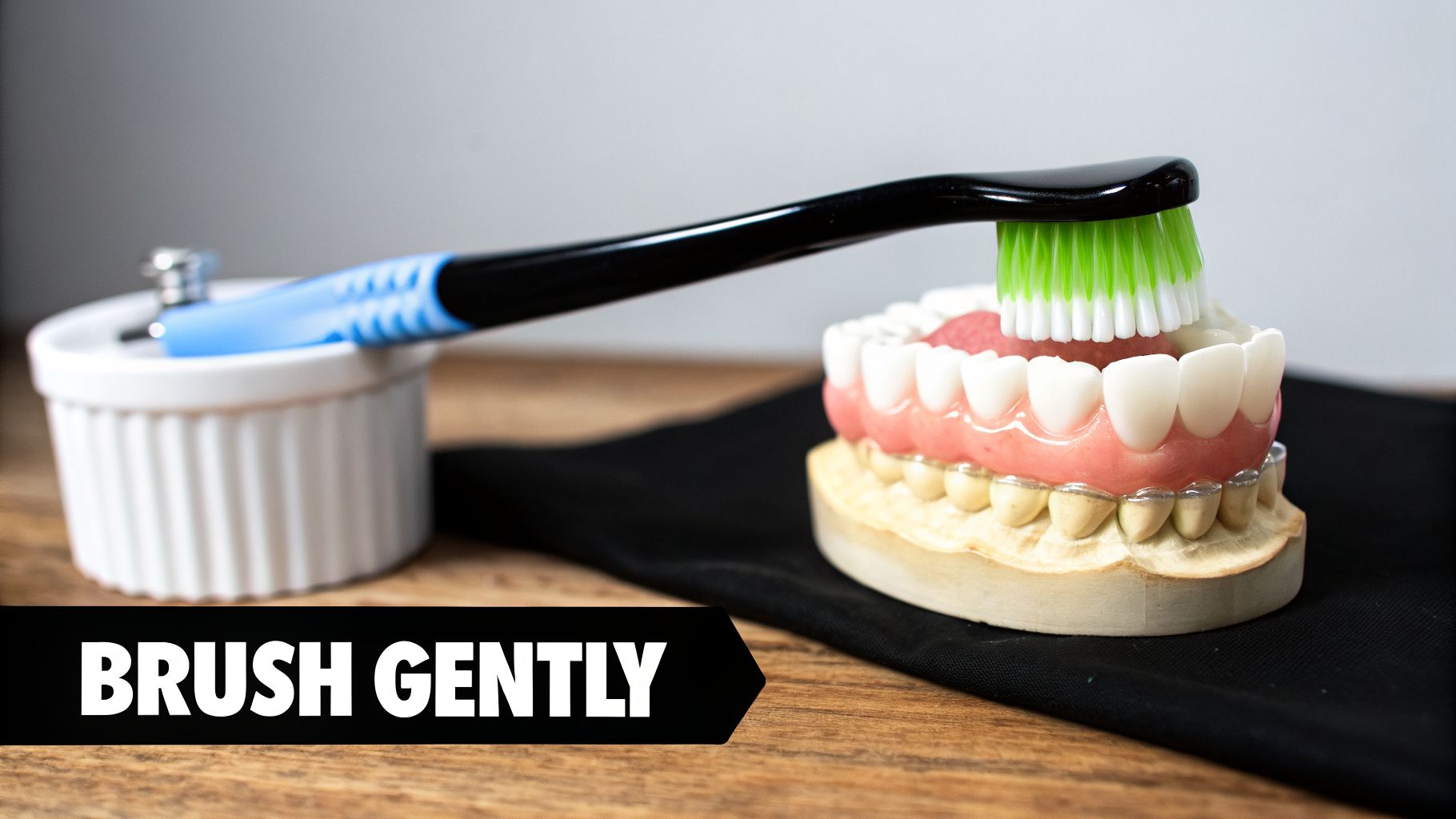
The single most important tool in your daily routine is a soft-bristled toothbrush. Brushes with medium or hard bristles are far too harsh for the delicate, polished surface of your veneers. They can also damage your gums, causing them to recede and expose the thin edge where the veneer meets your natural tooth.
A Step-by-Step Guide to Brushing
To get the most out of your at-home care, just follow these simple steps twice a day, for two minutes each time.
- Use a Pea-Sized Amount: Squeeze a small dab of your non-abrasive, fluoride toothpaste onto a soft-bristled brush. That's all you need.
- Angle the Brush: Hold your toothbrush at a 45-degree angle toward your gums. This angle allows the bristles to gently sweep away plaque from that critical area where the veneer, tooth, and gum tissue all meet.
- Use Gentle, Circular Motions: Forget aggressive back-and-forth scrubbing. Instead, use light pressure and small, circular motions. This technique is incredibly effective at removing plaque without scratching the porcelain or irritating your gumline.
The link between gentle care and a long-lasting smile is undeniable. A major analysis found that toothpastes with an RDA value below 50 preserve a veneer’s polish 3.5 times better than standard formulas. Even more, this gentle approach cut the formation of micro-cracks by 67% over three years. With improper toothpaste contributing to 35% of all porcelain fractures in the U.S., a gentle technique isn't just a suggestion—it's essential.
Don’t Forget to Floss
Flossing is just as crucial as brushing. It’s the only way to clean the tight spaces between your veneers where a toothbrush simply can’t reach.
When you floss, gently guide the string down between your teeth. Curve it into a "C" shape against the side of one veneer and slide it just beneath the gumline. Then, lift it out and repeat on the adjacent veneer. The key is to be careful not to "snap" the floss down hard, as this could catch on the delicate margin of the veneer.
This simple but powerful routine is your best defense against plaque buildup and staining. You can learn more about all the factors that play into the longevity of your new smile in our comprehensive guide on how long veneers last.
Your Partner in Cosmetic Dentistry in Vienna, VA
This guide is a perfect example of our core belief here at Vienna Dental Implant & Family Dentistry: patient education is the foundation of a lasting, beautiful smile. We see ourselves as your long-term partner, not just a dental office. Our goal is to help you achieve and maintain a smile you’re truly proud of.
Knowing the best toothpaste for veneers is a small but critical piece of protecting your investment, and our team is always here to provide that kind of practical, honest guidance. We want you to feel confident and in control of your oral health.
Comprehensive Care in a Comfortable Setting
From state-of-the-art cosmetic dentistry treatments like custom porcelain veneers and convenient same-day CEREC crowns to comprehensive family dentistry, our practice is designed to be your all-in-one dental home. We are proud to serve families in Vienna and the surrounding Northern Virginia communities, and we’ve worked hard to create a welcoming and completely judgment-free environment for every person who walks through our doors.
We also understand that dental visits can be a source of anxiety for many people. That’s why we offer gentle sedation dentistry options to ensure your experience is as relaxed and comfortable as possible. Your peace of mind is our priority, whether you're here for a routine cleaning or a full smile makeover.
At Vienna Dental Implant & Family Dentistry, we believe an informed patient is an empowered patient. Our goal is to give you the knowledge and tools you need to care for your smile with confidence, ensuring your results last for many years to come.
Ready to talk about your specific smile goals, or do you need personalized advice on caring for your veneers? Dr. Chauhan and our dedicated team in Vienna, VA, are here to help. Contact our office today to schedule your consultation and experience the difference that patient-focused, local dental care can make for you and your family.
Frequently Asked Questions About Veneer Care
After you leave our office with your brand-new smile, a few questions naturally come up as you settle into your new routine. We've put together answers to some of the most common ones we hear from our cosmetic dentistry patients in Vienna, VA, to give you complete peace of mind.
Can I Use an Electric Toothbrush with Veneers?
Absolutely. In fact, we often recommend them. An electric toothbrush is fantastic for veneers, as long as you use a soft-bristled head and a light touch. The consistent, gentle motion is perfect for effective cleaning without being harsh.
Many newer electric models even have a built-in pressure sensor that lights up or buzzes if you’re pushing too hard. This is an excellent feature that protects not only your veneers but your delicate gum tissue, too.
What Should I Do If My Veneers Get Stained?
First, don't panic, and definitely don't reach for whitening toothpaste or abrasive home remedies. These products will only create microscopic scratches on the veneer’s surface, which dulls the finish and can actually attract more stains over time.
Your first and only step should be to schedule a professional cleaning at our Vienna, VA office. We use specialized, low-abrasion polishing pastes and instruments designed specifically for cosmetic restorations. This process is the only way to safely lift surface stains and restore your veneers' original, brilliant luster without causing damage.
Remember, the porcelain itself is highly stain-resistant, but the bonding agent used at the very edges can sometimes pick up color. Professional cleanings are the safest and most effective way to manage this and keep your smile looking seamless.
Will Mouthwash Harm My Veneers?
Some mouthwashes can, yes. The main culprit to watch out for is alcohol. Mouthwashes with a high alcohol content can slowly soften and wear away the dental bonding material that holds your veneers securely to your teeth. Over time, this can weaken the bond and shorten the lifespan of your beautiful cosmetic work.
To keep your investment safe, our team at Vienna Dental Implant & Family Dentistry always suggests an alcohol-free mouthwash. For the best of both worlds, find an alcohol-free rinse that also contains fluoride. This will help protect the natural tooth structure underneath from decay, all without putting your veneers at risk.
How Often Should I See My Dentist with Veneers?
Your regular checkup schedule shouldn't change—we still need to see you every six months. If anything, these routine visits become even more crucial after you get veneers. They give our dental team the perfect opportunity to perform a professional cleaning and meticulously check the integrity of each veneer.
We’ll carefully inspect the bond, the margins where the veneer meets the tooth, and the health of the underlying tooth and gums. Think of these consistent checkups as the best insurance policy for your smile, ensuring we catch and address any tiny issues long before they can become bigger problems.