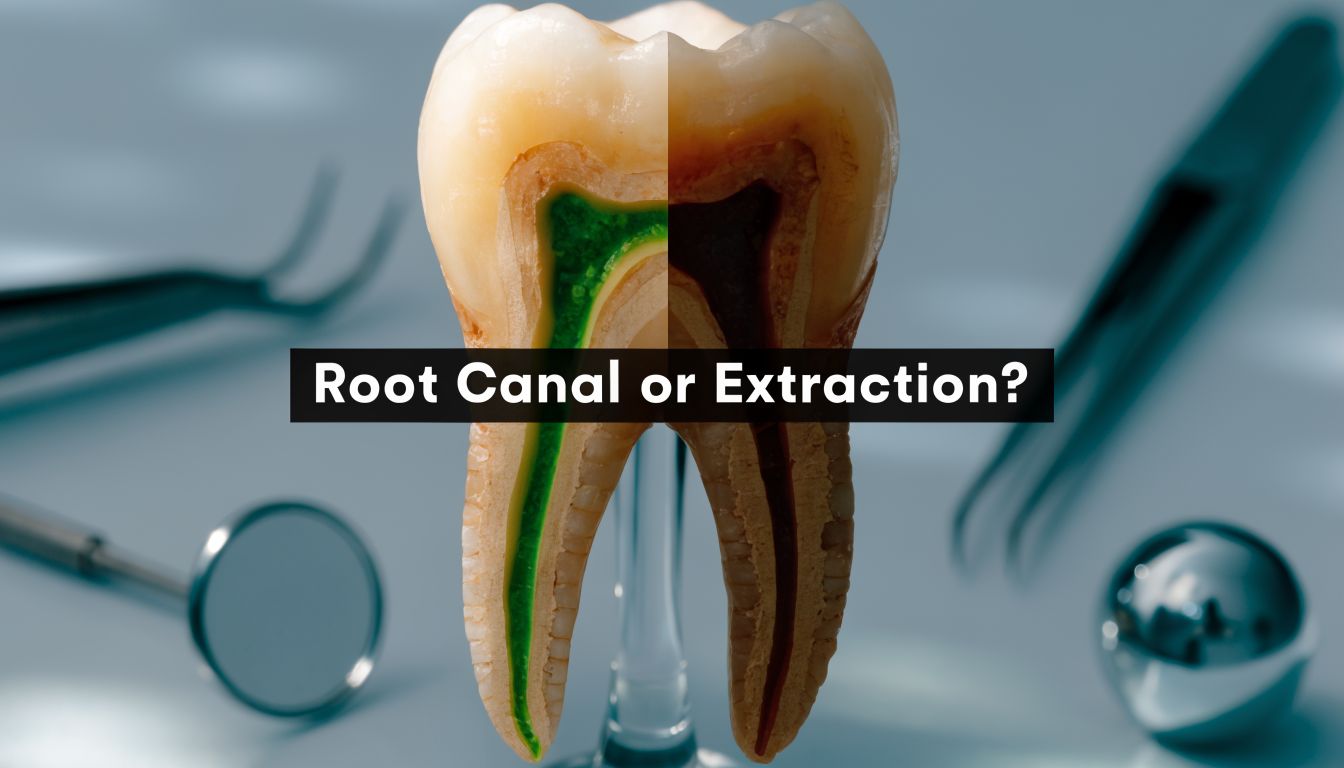
When you’re dealing with a throbbing molar, the choice between a root canal and an extraction can feel overwhelming. At Vienna Dental Implant & Family Dentistry, we want to reassure you that the decision is often simpler than it seems: a root canal saves your natural tooth, while an extraction removes it for good. As your trusted local provider in Vienna, VA, we believe that saving your tooth is almost always the best choice for your long-term health, function, and confidence.
Facing a serious dental issue can be unsettling, but you are not alone. Our team is here to reduce your anxiety by explaining your treatment options clearly and simply, helping you make the best choice for your smile.

The Molar Dilemma: Understanding Your Options in Vienna, VA
A sudden, severe toothache in a back molar can bring your life to a screeching halt. It makes it hard to eat, sleep, or even think straight. When you visit us at Vienna Dental Implant & Family Dentistry, you’ll receive a thorough evaluation and a clear explanation of your situation. This isn’t just about stopping the pain; it's a choice that will impact your health, your finances, and your smile for years to come.
We get it. We understand the anxiety this choice can create. Our goal is to give you clear, honest guidance so you can make an informed decision without feeling pressured. We see ourselves as your partners in oral health, here to explain every option and help you choose the path that aligns with your personal goals.
Comparing Your Two Main Options
Deciding between a root canal and an extraction means looking at the big picture. It’s not just about what’s quickest or cheapest today. You have to consider the procedure itself, the recovery, and the future of your oral health.
Here’s a quick look at what each path involves:
| Consideration | Root Canal Therapy | Molar Extraction |
|---|---|---|
| The Goal | To save your natural tooth by removing infection. | To completely remove the problematic tooth. |
| The Outcome | Your tooth is preserved and restored with a crown. | The tooth is gone, leaving a gap in your smile. |
| The Procedure | The inside of the tooth is cleaned out, but the tooth itself remains. | The entire tooth structure, root and all, is removed. |
| Future Steps | A protective dental crown is almost always necessary. | Replacing the tooth with an implant or bridge is recommended. |
Why This Decision Matters for Your Future
Choosing to save your tooth with a root canal helps maintain your natural bite, prevents jawbone loss, and keeps your other teeth from shifting out of place. While an extraction might seem like a simpler fix for the immediate pain, it creates a new challenge: a missing tooth.
A missing molar can trigger a domino effect of oral health issues, including difficulty chewing, shifting teeth, and a change in your facial structure over time. That's why extraction is often just the first step in a longer, more complex restorative dentistry journey.
This guide will walk you through every aspect of the root canal or extraction molar debate. Our team at Vienna Dental Implant & Family Dentistry is here to provide the expert, compassionate care you deserve as you navigate this important choice for your oral health in Vienna, VA, and the surrounding Northern Virginia communities.
A Closer Look: Root Canal vs. Extraction Procedure
When you’re dealing with a badly damaged or infected molar, the pain and uncertainty can be overwhelming. You’re often presented with two very different paths: a root canal to save the tooth or an extraction to remove it. It's a significant decision, and at Vienna Dental Implant & Family Dentistry, we believe the best choice is one you make with confidence and clarity.
The big question we need to answer together is whether your natural tooth can, and should, be saved. Let’s walk through what each option really means for you, moving past the myths and focusing on your long-term health and comfort.
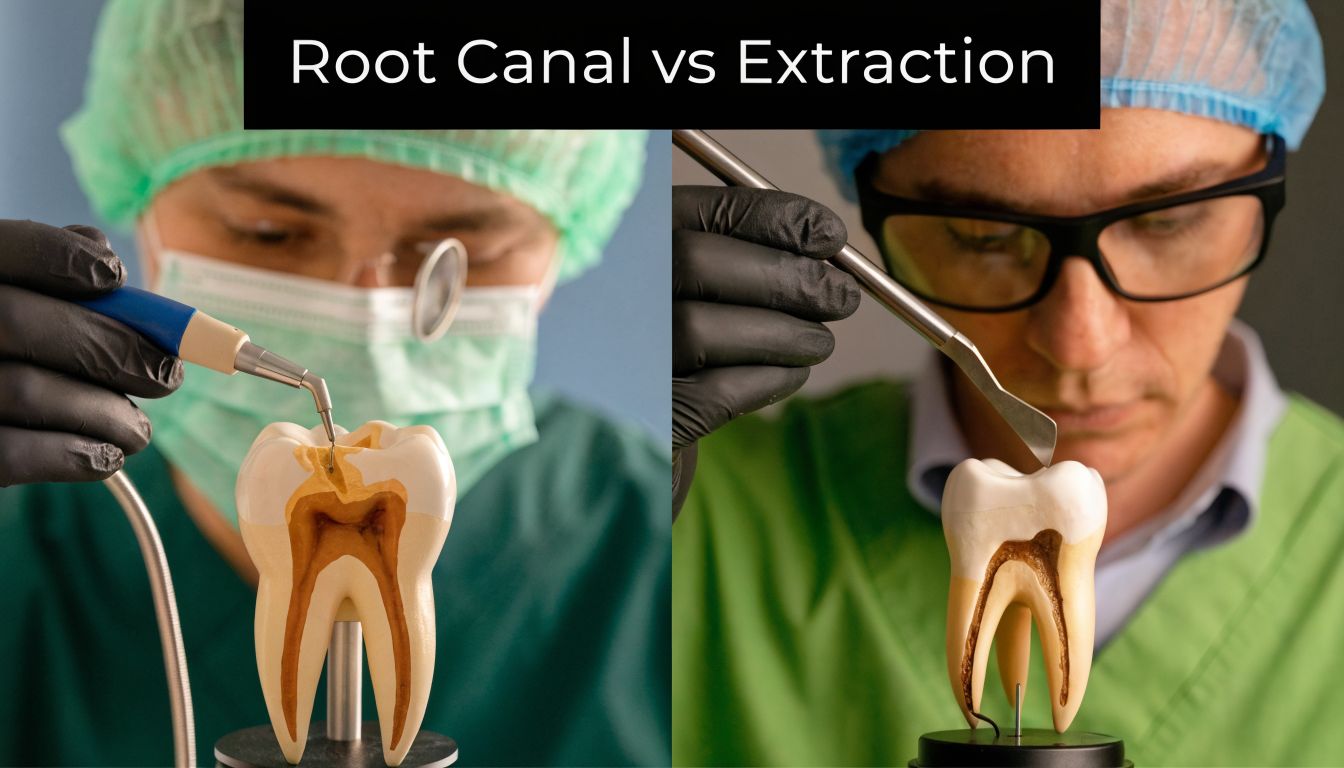
Root Canal vs. Molar Extraction At a Glance
To simplify this crucial decision, it helps to see the core differences side-by-side. Think of this table as a quick reference guide to the fundamental purpose and outcome of each procedure.
| Factor | Root Canal Therapy | Molar Extraction |
|---|---|---|
| Main Goal | Save the natural tooth by removing infection from the inside. | Remove the entire tooth to eliminate the source of pain or infection. |
| Procedure Time | Typically 1-2 visits of about 60-90 minutes each. | Usually a single visit, around 20-60 minutes per tooth. |
| Tooth Outcome | Your natural tooth remains in your jaw, restored with a crown. | The tooth is gone, leaving a gap that needs a replacement plan. |
| Future Restoration | A protective dental crown is always required. | A dental implant or bridge is highly recommended to fill the space. |
While this gives you a snapshot, the best choice always depends on your specific situation. The table highlights that a root canal is about restoration, while an extraction is about removal and subsequent replacement.
The Core Philosophy: Saving vs. Removing the Tooth
The most fundamental difference between these two paths is their objective. A root canal is a preservation effort. We go inside the tooth to meticulously clean out the infection and decay from the pulp and root canals, then seal it to protect it from any future problems. The goal is to keep your natural tooth right where it belongs.
An extraction, on the other hand, is a definitive removal. It solves the immediate problem by taking out the tooth entirely. While this eliminates the source of infection, it opens the door to new considerations, like the need to fill the gap left behind to maintain your bite and smile. This is where our expertise in restorative dentistry, including dental implants, becomes crucial.
What to Expect During the Procedure
Knowing the step-by-step process can do wonders for easing any anxiety. Both treatments begin with making you completely numb and comfortable, but from there, the journeys diverge.
Root Canal Therapy in Our Vienna Office
A root canal is a precise, internal cleaning of your tooth. Here’s how our team handles it:
- Numbing and Access: First, we ensure the tooth and surrounding area are profoundly numb. A small opening is then made in the crown of the molar to gently access the inner pulp chamber.
- Cleaning and Shaping: The infected or inflamed pulp is carefully removed from inside the tooth. We then use specialized instruments to clean, shape, and disinfect the tiny canals within the roots.
- Filling and Sealing: Once spotless, the canals are filled with a rubber-like, biocompatible material called gutta-percha. This seals the tooth from the inside out, preventing bacteria from getting back in.
- Restoration: The process is finished by placing a temporary filling. You will then return for a permanent dental crown, which is essential to protect the tooth and restore its full strength and chewing function.
Molar Extraction
An extraction is more straightforward but involves removing the tooth from your jaw.
- Numbing the Area: We start by making sure you are completely numb and won't feel any pain during the procedure.
- Loosening the Tooth: Our dentist uses special tools to gently expand the socket and loosen the tooth from the ligaments holding it in place.
- Removing the Tooth: Once it’s sufficiently loose, the tooth is carefully lifted from the socket.
A root canal is like a deep clean for your tooth, saving its structure. An extraction removes the tooth and the problem with it, which is why it’s our last resort when a tooth is too damaged to be saved.
Life After the Procedure: What Comes Next
When you leave our Vienna, VA office, your path forward will look quite different depending on the treatment you received.
After a root canal, your tooth is still there, working for you. Recovery is usually very quick, with most people feeling back to normal by the next day. The main follow-up is getting your permanent crown placed to ensure the tooth is protected for the long haul.
Following an extraction, you’ll leave with a gap and some gauze to control bleeding. The socket needs several weeks to heal properly, and it's crucial to follow aftercare instructions to avoid complications like a dry socket. Our guide on same-day tooth extraction has great information on this process. This choice is just the first step; the next is planning for a dental implant or bridge to restore your smile’s function and appearance.
Pain and Recovery: A Realistic Comparison
Let's face it, when you're weighing a root canal against an extraction, the biggest question on your mind is probably a simple one: which one is going to hurt less? It's completely normal to worry about pain, and there's a common misconception that just pulling the tooth is the easier, less painful route. In our experience, the clinical reality often tells a very different story.
At Vienna Dental Implant & Family Dentistry, your comfort is our absolute priority. With modern anesthetics and our sedation dentistry options, a root canal is often no more uncomfortable than getting a standard filling. The real difference between the two procedures isn't felt during the treatment—it's in the recovery afterward.

Unpacking the Myth of the Painful Root Canal
The idea that root canals are terribly painful is, thankfully, very outdated. The truth is, the procedure is designed to relieve the severe pain caused by a deep infection, not to cause more of it. Most of the discomfort our patients feel is from the infection before they even get to our Vienna office. The root canal treatment actually removes the source of that pain.
Believe it or not, the data shows that extraction isn't the less painful choice. The American Association of Endodontists reports that pulling a tooth is often more painful than the original infection, and the extraction procedure itself can cause more discomfort than root canal therapy. If you'd like to read more on how the two compare, you can explore additional insights on the root canal vs. extraction debate.
The entire point of a root canal is to get you out of pain and save your natural tooth. We perform the procedure with profound local anesthetic, and for our anxious patients, we offer sedation to ensure you are completely relaxed and comfortable from start to finish.
A Head-to-Head Look at Healing Timelines
The recovery period is where the differences between these two treatments really come into focus. Time and time again, we see that saving your natural tooth leads to a smoother, faster recovery.
Root Canal Recovery:
- Immediately After: Once the numbness wears off in a few hours, you might feel some mild soreness or tenderness. This is easily managed with over-the-counter pain relievers like ibuprofen.
- The Next Day: The vast majority of our patients are back to their normal routines, including work or school, the very next day.
- Long-Term: The key here is that your tooth never leaves your mouth. Once it’s restored with a permanent crown, it feels and functions just like any other tooth, and healing is simplified.
Molar Extraction Recovery:
- Immediately After: You'll leave our office with an open socket that needs to form a protective blood clot. You’ll be biting on gauze to manage bleeding, and the first 24 hours are critical for proper healing to begin.
- The First Few Days: Swelling and discomfort are much more common and can last for several days. You’ll need to stick to a soft-food diet and avoid activities like using a straw to protect the site.
- Potential Complications: The main risk after an extraction is a dry socket. This is a painful condition that happens if the blood clot gets dislodged, exposing the nerve and bone. It can significantly delay healing and require more follow-up visits to our Vienna office.
For a deeper dive into the root canal experience, check out our guide on root canal recovery.
When you break it down, choosing a root canal is often a choice for less post-op discomfort and a much faster return to your daily life. The entire journey—from feeling comfortable in the chair to a smooth, predictable healing process—is why we so often recommend saving your molar. It’s better for your short-term comfort and your long-term health.
The Long-Term Financial Impact of Your Molar Decision
When you're dealing with a painful molar, it’s natural to focus on the immediate cost of treatment. Many people see the lower upfront price of an extraction and assume it’s the most affordable path forward. While pulling the tooth might seem cheaper at first glance, this is often a short-sighted view that can lead to significant, cascading expenses down the line.
At Vienna Dental Implant & Family Dentistry, we always encourage our patients to look at the bigger picture—the lifelong financial journey of their smile. Choosing to save your natural tooth with a root canal is very often the more economical decision over time. It’s a true investment in preventing future complications and far more costly procedures.
The Hidden Costs of Tooth Extraction
The initial fee for an extraction is just the tip of the iceberg. When a molar is removed, it creates a gap that your body immediately starts trying to manage, and not always in a helpful way. This sets off a chain reaction of events, each with its own price tag.
Let’s look at the financial road that often follows a molar extraction:
- The Extraction Itself: This is your first expense. It seems lower than a root canal, but it’s really just step one in a much longer process.
- Bone Grafting: Without a tooth root to stimulate it, the jawbone in that empty space begins to shrink and recede. To prepare the area for a future implant, a bone graft is usually needed to rebuild this lost bone, adding another procedure and cost to your plan.
- Tooth Replacement: Simply leaving a gap isn’t a healthy long-term option. It can cause your other teeth to shift, create bite problems, and lead to even more bone loss. Because of this, you have to factor in the cost of a replacement. The best solution is often a dental implant, which is a key service we provide at our Vienna, VA practice.
Comparing Lifetime Costs: Root Canal vs. Extraction and Replacement
The real financial comparison isn't between a root canal and an extraction. It’s between a root canal and an extraction plus the cost of the necessary replacement.
The most compelling economic argument extends far beyond the initial treatment. Research indicates that a root canal followed by a crown costs considerably less over a lifetime than extraction followed by an artificial tooth replacement. For families in Northern Virginia evaluating their options, the math becomes clear when you consider that a preserved natural tooth avoids these cascading dental expenses. Find out more about the cost-benefit analysis of root canals vs. extractions.
Here's how the two paths usually unfold:
- Path 1: Root Canal: This path includes the root canal procedure and a permanent dental crown to protect the tooth. This two-step process saves your natural tooth, and with proper care, it can last a lifetime. In most cases, your expenses end there.
- Path 2: Extraction: This path involves the extraction fee, a potential bone graft fee, and then the significant cost of a dental implant and crown or a dental bridge. A dental implant is the gold-standard replacement, but it is also the most significant investment. Our team can help you understand these figures in detail, and you can learn more about how much dental implants cost to better plan for this possibility.
When you add up the multiple procedures required to properly manage a missing tooth, the total cost often far exceeds that of saving the tooth in the first place.
Making Care Affordable in Vienna, VA
We understand that dental costs are a major concern for families here in Vienna and throughout Northern Virginia. At Vienna Dental Implant & Family Dentistry, we are committed to providing transparent pricing and flexible options to make the best possible care accessible to everyone.
We offer an in-house Smile Savings Plan for patients without insurance, which provides significant discounts on procedures like root canals and crowns. We also partner with third-party financing companies to offer manageable monthly payment plans. Our team will work with you to find a solution that fits your budget, so you can make a decision based on your long-term health, not just short-term costs.
How Your Choice Affects Your Overall Health and Quality of Life
Deciding between a root canal and a molar extraction is about more than just a single tooth. It’s a choice that will echo through your daily life for years to come, influencing how you eat, speak, and feel about your smile. At Vienna Dental Implant & Family Dentistry, our goal is to help you see beyond the immediate pain and understand the full long-term picture.
Saving your natural molar with a root canal is all about preserving the beautiful, intricate system that is your mouth. Your teeth are designed to work together in perfect harmony, creating a stable and efficient bite. A root canal works to maintain that balance.
On the other hand, extracting a molar—while sometimes the only option—creates a significant gap. It's like removing a critical support beam from a house; the surrounding structure will inevitably shift and weaken over time.

The Ripple Effect of Saving Your Tooth
When you choose a root canal, you're choosing to keep your natural tooth right where it belongs, anchored by its strong root into your jawbone. This provides several critical, lifelong benefits that are easy to take for granted until they’re gone.
- Preserves Chewing Function: Keeping your molar means you can chew properly on both sides of your mouth. This helps with digestion and lets you enjoy all your favorite foods without a second thought.
- Maintains Jawbone Health: The root of your tooth provides constant stimulation to your jawbone, keeping it strong and dense. Saving the tooth prevents the bone loss (resorption) that always begins after an extraction.
- Prevents Teeth from Shifting: Every single tooth in your mouth helps hold its neighbors in place. By keeping your molar, you stop the adjacent teeth from drifting into the empty space, which can set off a chain reaction of bite problems.
This isn't just theory; it has a real impact on your quality of life. A major study on oral health found that children who had root canals reported a significantly higher quality of life than those who had an extraction. In fact, 66% of the root canal group reported optimal outcomes, compared to just 33.3% of the extraction group. That means saving the tooth nearly quadrupled the odds of an improved quality of life. You can discover more about how treatment choice impacts life quality in the full study.
The Domino Effect of Tooth Extraction
Pulling a molar might solve the immediate problem of pain or infection, but it instantly creates a new one: a missing tooth. The consequences of that gap go far beyond just looks, setting off a domino effect that can alter your entire oral health over time.
A missing molar isn't just an empty space; it's an invitation for future problems. The subsequent shifting of teeth, bone loss, and difficulty chewing can fundamentally alter the health and function of your mouth for years to come.
Think about the long-term consequences that unfold:
- Chewing Difficulties: When you lose a powerful back tooth, you naturally start chewing on the other side. This can lead to jaw strain and cause uneven wear on your remaining teeth.
- Tooth Migration: The teeth next to the gap will begin to tilt and drift into the empty space. At the same time, the tooth in the opposite jaw can over-erupt, growing down into the gap. This destabilizes your entire bite.
- Changes to Facial Appearance: Over many years, significant bone loss from one or more extractions can cause your cheeks and jaw to look sunken. This can prematurely age your appearance.
Choosing between a root canal or extraction molar is a major decision point in your oral health journey. The path of preservation—saving the tooth—secures the function, health, and confidence that come with your natural smile. Here in our Vienna, VA practice, we’ve seen firsthand how this choice supports a better quality of life for our patients from all over Northern Virginia.
Making the Right Molar Decision with Vienna Dental Implant & Family Dentistry
At the end of the day, after weighing all the pros and cons, the choice between a root canal or an extraction for a damaged molar comes down to you. There really is no single "right" answer that applies to everyone. The best path forward is the one that fits your tooth’s specific condition, your overall health, and what you want for your smile long-term.
Here at Vienna Dental Implant & Family Dentistry, we see ourselves as your partners in this decision. Our team is here to offer clear, compassionate guidance, so you feel confident and in control of your own health journey.
Your Partners in Personalized Care
Our entire approach is built on putting you, the patient, first. That means we take the time to actually listen to your concerns, answer every single question you have, and explain your options without any judgment. We want you to understand the why behind our recommendations, whether we’re suggesting a root canal to save a natural tooth or planning for an extraction as a necessary final step.
The right decision for your molar isn't just a clinical one; it’s a personal one. We are here to provide the expert diagnosis and compassionate support you need, ensuring your choice is one you feel good about for years to come.
This commitment to personal care is backed by our investment in advanced technology. For example, if you need a crown after your root canal, our CEREC same-day crown technology allows us to design, mill, and place your permanent restoration in a single appointment. That means less time in the dental chair and a faster return to your normal routine.
From Emergency Pain to a Complete Smile
Whether you’re right here in Vienna or in the surrounding Northern Virginia area, our practice is equipped to handle every part of your dental journey. Think of us as your home for everything from urgent care for a toothache to the comprehensive restorative work needed to rebuild your smile from the ground up. Our wide range of services includes family dentistry, cosmetic dentistry, and advanced treatments like Invisalign.
- Emergency Appointments: We always prioritize patients in pain, offering same-day appointments to get you comfortable and address the immediate problem.
- Expert Root Canals: We perform root canals with precision and a constant focus on your comfort, doing everything we can to save your natural teeth.
- Skilled Extractions: When an extraction is the only choice, we make sure the procedure is smooth and that you have a clear plan for what comes next.
- Comprehensive Restoration: From single dental implants to bridges and more complex full-mouth solutions, we can restore the function and beauty of your smile right here in our Vienna, VA office.
If you’re facing the difficult decision of a root canal or extraction molar, you don’t have to figure it out on your own. Let us help you find the best path forward for your health and happiness. Schedule a consultation at Vienna Dental Implant & Family Dentistry today, and let’s work together to protect your smile.
Answering Your Questions About Molar Treatments
When you're dealing with a painful molar, it’s completely natural to have questions. The decision between a root canal and an extraction can feel overwhelming, and at Vienna Dental Implant & Family Dentistry, we believe in giving you clear, straightforward answers. Our goal is to help our patients in Vienna, VA and the surrounding areas in Northern Virginia feel confident and empowered in their dental care choices.
Here are some of the most common questions we hear in our office.
Is a Root Canal Always the Best Choice for a Molar?
While our primary goal is almost always to save your natural tooth, a root canal isn’t the right fit for every single situation. We prioritize keeping your original teeth whenever we can, as this maintains your natural bite and prevents the bone loss that inevitably follows an extraction.
However, sometimes an extraction becomes the more practical long-term solution. This might be the case if:
- The Tooth Is Severely Fractured: A deep crack extending below the gumline can make it impossible to restore the tooth reliably for the long haul.
- Decay Is Too Widespread: If there isn’t enough healthy tooth structure left to support a crown after cleaning out the decay, saving the tooth may simply not be feasible.
- The Infection Is Too Advanced: In rare cases, an infection might be too severe or complex for even a meticulously performed root canal to resolve successfully.
A thorough, one-on-one evaluation at our Vienna, VA practice is the only way to know for sure which path is right for you.
Do I Really Have to Replace an Extracted Molar?
Yes, we strongly recommend it. Choosing not to replace an extracted molar can set off a chain reaction of oral health problems down the road. That empty space creates a domino effect: nearby teeth start to drift and tilt into the gap, the opposing tooth can over-erupt, and your jawbone will begin to shrink from the lack of stimulation.
This can lead to bite problems, new difficulties with chewing, and even noticeable changes to your facial structure over time.
Key Takeaway: Replacing a missing molar with a solution like a dental implant is a crucial investment in your health. It does more than just restore your smile; it protects the long-term health and stability of your entire mouth. As the premier implant dentist in Vienna, VA, we specialize in these long-term solutions.
What if I Have a Lot of Dental Anxiety?
You are not alone, and we are absolutely here to help you through it. Our Vienna practice is proud to offer sedation dentistry options to ensure you feel completely relaxed and comfortable during your procedure.
Whether you're coming in for a root canal or an extraction, sedation can help you get the essential care you need without the stress and fear that so many people feel.
Can a Molar That Had a Root Canal Get Infected Again?
Root canal therapy has an incredibly high success rate—over 95%, in fact. However, in a very small number of cases, a tooth can become reinfected months or even years later.
This can happen if new decay creates a pathway for bacteria to re-enter the tooth, or if a tiny, complex canal was missed during the initial treatment. If this happens, don't worry. We can often perform a retreatment procedure at our Vienna office to clean the tooth again and save it for good.