Congratulations on completing your root canal at Vienna Dental Implant & Family Dentistry! This is a huge step toward saving your natural tooth and, most importantly, getting rid of that nagging pain. If you've been searching for a trusted "dentist near me" in Vienna, VA, you can feel confident you're in caring hands. Now, the focus shifts to a smooth and easy recovery.
The next 24 hours are the most important for a comfortable healing process. While "recovery" might sound intense, it's usually much simpler than patients expect. Think of it as a day of rest and gentle care for your mouth, guided by your local Vienna dental team.
Your First 24 Hours After a Root Canal

Let's clear the air: root canal recovery isn't the ordeal it's often made out to be. Modern dentistry has made the entire process incredibly efficient and comfortable. In fact, according to the American Association of Endodontists, about 15 million of these procedures are done every year in the U.S. with success rates hitting over 95%. You’re in good company.
At our Vienna, VA, practice, we always send you home with personalized instructions, but here’s a general roadmap for what to expect during this initial healing phase. This is part of our commitment to restorative dentistry excellence for our community.
Navigating the Initial Hours
Your top priority after leaving our Vienna office is simple: take it easy. Your mouth will be numb from the local anesthetic for a few hours. This is part of our commitment to your comfort during the procedure, but it’s crucial to be mindful while you can’t feel your lip, tongue, or cheek to avoid accidentally biting them.
- Wait to eat until the numbness is completely gone. Chewing while you can't feel your mouth is a recipe for biting your cheek or tongue.
- Start with liquids or very soft foods once you can feel everything again. Think smoothies, yogurt, or lukewarm soup.
- Put your feet up and rest. Your body needs its energy to heal, so hold off on the gym or any heavy lifting for the rest of the day.
This quick-reference table breaks down what you can expect as the day goes on.
Your First 24 Hours Root Canal Recovery Timeline
| Timeframe | What to Expect | Actionable Tip |
|---|---|---|
| 0-3 Hours Post-Op | Numbness from the anesthetic is still in effect. You won't have much sensation in the treated area. | Avoid all eating and hot drinks. Be careful not to bite your cheek, tongue, or lip. |
| 3-6 Hours Post-Op | The anesthetic will start wearing off. You might begin to feel mild tenderness or sensitivity. | Take an over-the-counter pain reliever like ibuprofen before the numbness fully disappears to stay ahead of any discomfort. |
| 6-12 Hours Post-Op | Some mild swelling or soreness is normal. This is your body's natural healing response kicking in. | Apply a cold compress to the outside of your cheek for 20 minutes on, 20 minutes off to minimize swelling. |
| 12-24 Hours Post-Op | The initial tenderness should be well-managed. You'll likely feel much more comfortable. | Stick to soft foods. Get a good night's rest, propping your head up with an extra pillow to help reduce any minor swelling. |
Following this timeline can make a world of difference in your comfort level.
Managing Discomfort as Anesthesia Fades
It's completely normal to feel some mild tenderness or sensitivity in the area once the anesthetic wears off. This is just a sign that your body has started the healing process. We strongly recommend taking an over-the-counter pain reliever like ibuprofen before the numbness subsides completely. This proactive approach helps get ahead of any discomfort before it has a chance to start.
At Vienna Dental Implant & Family Dentistry, your well-being is our top priority. If you experience pain that feels severe or isn't getting better with standard pain medication, please don't hesitate to call our Vienna office. We're here to help our neighbors in Vienna and surrounding Northern Virginia communities.
By being gentle with yourself and the treated tooth, you're setting the foundation for a quick and uneventful recovery.
How to Manage Discomfort and Swelling Effectively
It’s completely normal to feel some mild tenderness and see a bit of swelling after your root canal. This isn't a sign of trouble; it's simply your body's natural healing process kicking into gear. The good news is that managing these symptoms is usually quite straightforward, and our team is here to guide you.
The key to a smooth root canal recovery is staying ahead of the discomfort. We find the best approach is to take an over-the-counter anti-inflammatory, like ibuprofen, before the local anesthetic completely wears off. This preemptive step helps get the inflammation under control before it really has a chance to start.
Using Cold Compresses Correctly
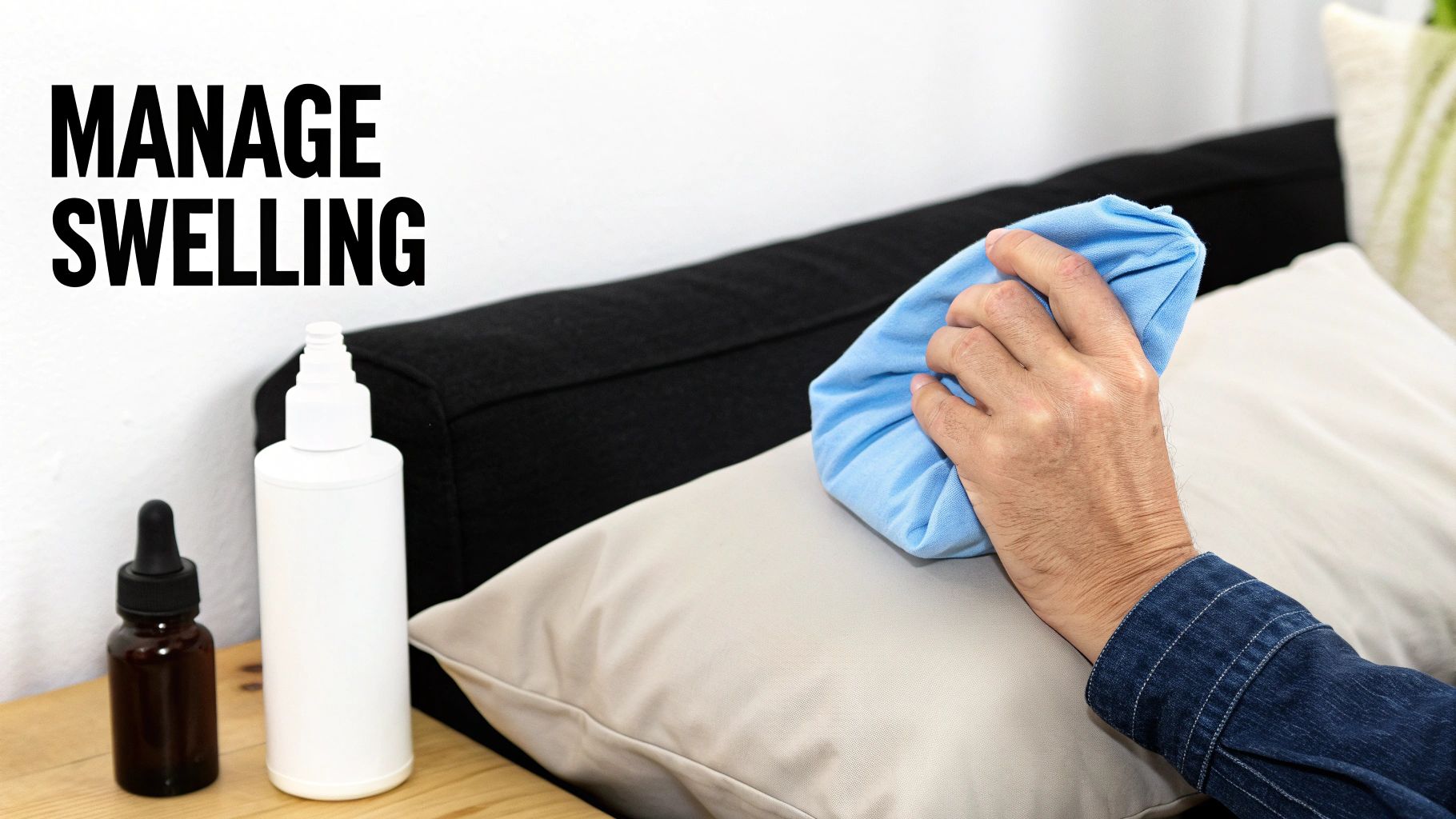
Along with medication, a cold compress will be your best friend for the first day or two. Applying a cold pack to your cheek near the treated area can work wonders for reducing swelling. The cold helps constrict the blood vessels, which limits inflammation and provides a welcome numbing effect.
For the best results, get into a simple rhythm:
- Apply for 20 minutes: A commercial ice pack, a bag of frozen peas, or even ice cubes in a sealed bag wrapped in a thin towel works perfectly.
- Remove for 20 minutes: This gives your skin a necessary break and prevents any irritation from the cold.
- Repeat as needed: Keep this cycle going for the first 24-36 hours after your procedure, especially when you’re resting.
This on-and-off cycle is incredibly effective at minimizing the puffiness that can sometimes follow dental work.
Smart Strategies for Added Comfort
Beyond medication and ice, a few other small adjustments can make a big difference in how you feel. When you lie down to rest or sleep, try propping your head up with an extra pillow. This simple elevation helps prevent fluid from pooling in the area overnight. It's a small change, but it can help you wake up feeling noticeably better.
Don't hesitate to reach out if your discomfort feels severe, isn't improving with over-the-counter medication, or if swelling increases after the third day. The team at Vienna Dental Implant & Family Dentistry is always here to support our patients in Vienna, VA, and Northern Virginia.
Remember to be gentle with the area for a few days. Avoid chewing on the side of the treated tooth until you get your final restoration, and stick to softer foods. For more helpful tips and to access patient forms, feel free to browse our patient resources. By taking these simple, gentle precautions, you’ll be back to feeling like yourself in no time.
Your Healing Diet and Oral Care Routine
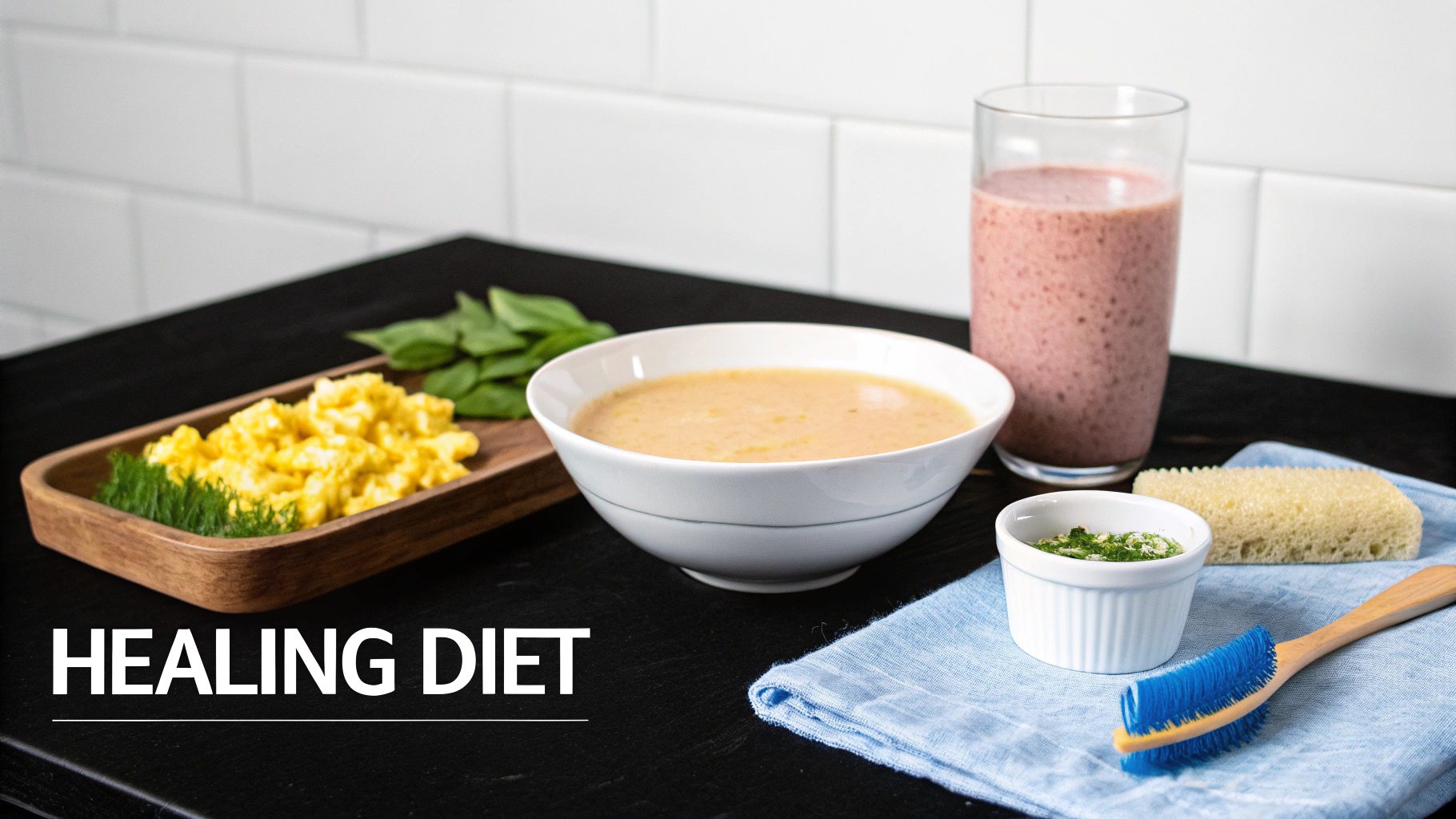
What you eat—and how you take care of your mouth—in the days following your root canal plays a huge role in how quickly and comfortably you heal. Your main goal is simple: give your body the nutrition it needs to recover without putting any stress on the treated tooth. That means sticking to soft, easy-to-chew foods for the first few days.
But a healing diet doesn’t have to be boring. Think beyond just clear broth. You can still enjoy satisfying meals like scrambled eggs, oatmeal, yogurt, smoothies, and mashed potatoes. These options are packed with protein and nutrients but require very little chewing, which is exactly what that tooth needs right now.
Smart Food Choices for a Smooth Recovery
While soft foods are your best friend, knowing what to avoid is just as important. For starters, you'll want to chew exclusively on the opposite side of your mouth until your permanent crown is in place. But even then, certain foods can cause problems no matter how careful you are.
For the next few days, it's best to steer clear of anything:
- Hard: Think nuts, hard candies, raw carrots, or tortilla chips. These can easily crack the temporary filling or even the tooth itself.
- Chewy or Sticky: Things like caramels, taffy, and even some tough breads can grab onto the temporary filling and pull it right out.
- Extremely Hot or Cold: That tooth has been through a lot, and it's likely to be sensitive to temperature extremes for a bit. Stick with lukewarm soups and room-temperature drinks to be safe.
- Spicy or Acidic: These ingredients can irritate the gum tissue around the tooth while it’s trying to heal.
By being mindful of your diet, you’re protecting all the delicate work we’ve done and giving your mouth the best possible environment to heal without any setbacks.
Gentle Yet Effective Oral Hygiene
Keeping your mouth clean is absolutely critical for preventing infection and promoting a fast recovery, but your normal routine needs a few tweaks. You definitely should continue to brush and floss—just with a much gentler approach.
When you brush, use a soft-bristled toothbrush and be extra careful around the treated area. No aggressive scrubbing. For flossing, slide the floss through gently instead of snapping it down against the gums, especially near the temporary filling. The idea is to clean without causing any trauma.
Pro Tip: One of the best things you can do for your healing mouth is a simple warm saltwater rinse. Mix half a teaspoon of salt into a glass of warm water, then swish gently for about 30 seconds. Do this two or three times a day, especially after you eat. It’s incredibly effective at reducing inflammation and keeping the area clean.
Here at Vienna Dental Implant & Family Dentistry, we’re with you every step of the way. If you have any questions at all about what to eat or how to care for your tooth, our Vienna, VA, team is always just a phone call away. Proper care at home is the key to getting the best possible outcome from your treatment.
Why Your Final Restoration Is So Important
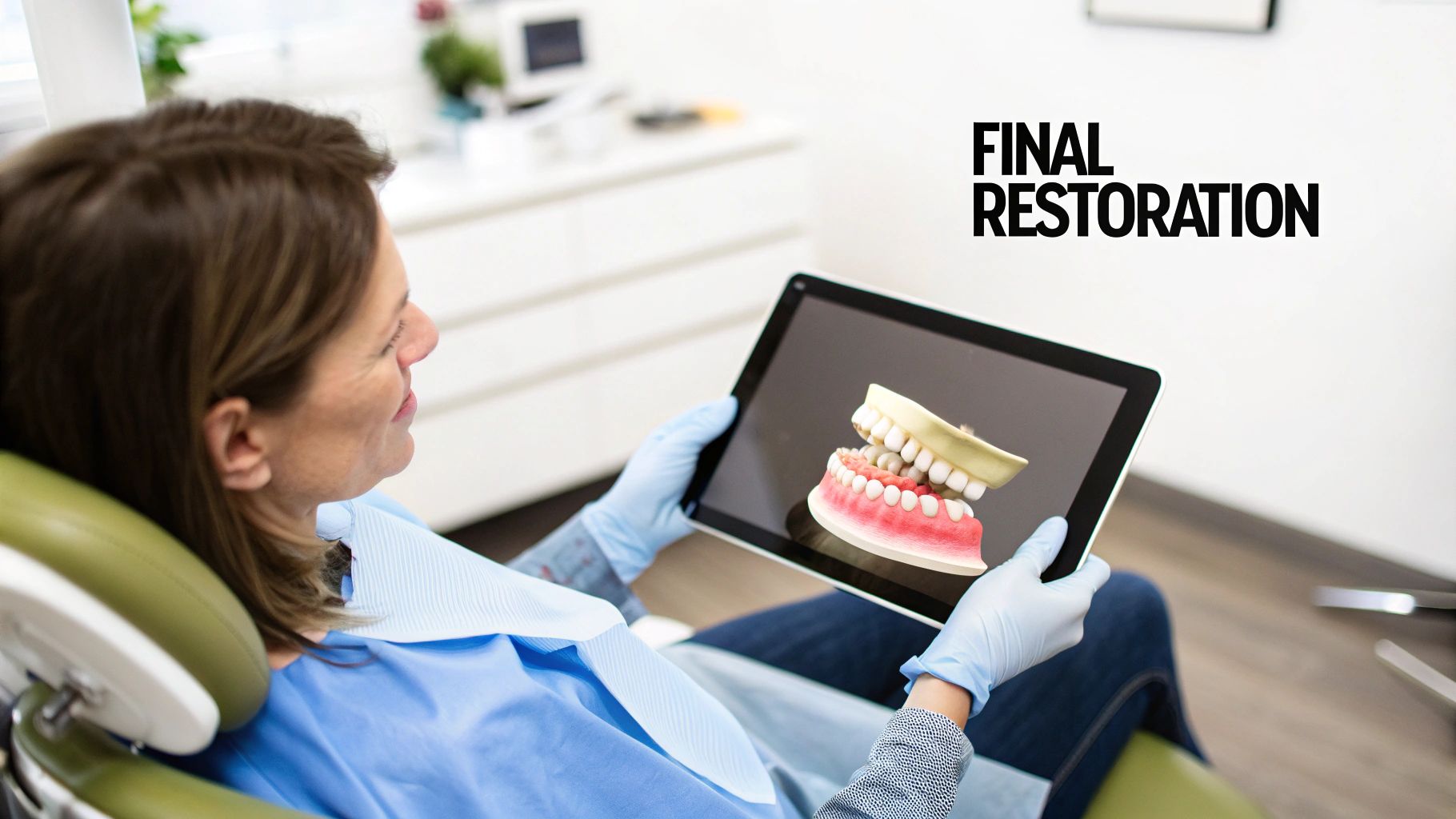
Getting through a root canal is a huge win for your oral health, but the journey isn't quite over yet. That temporary filling we place at the end of your appointment is exactly what it sounds like—temporary. The final, non-negotiable step in your root canal recovery is getting a permanent restoration, which in most cases is a dental crown.
Think of it this way: the root canal treats the inside of the tooth. Now we have to protect the outside. A tooth that's had a root canal can become more brittle over time because we've removed the inner pulp, which contained its nerve and blood supply. This makes it much more susceptible to cracking or fracturing under normal chewing pressures.
Why a Crown Is Essential for Long-Term Success
A dental crown is like a helmet for your treated tooth. It covers the entire visible portion, absorbing the forces of biting and chewing and spreading them out evenly. This structural support is absolutely critical to prevent the tooth from breaking down the road, which could turn a successful root canal into a failed tooth that needs to be pulled. This is a key part of comprehensive cosmetic dentistry and preserving your smile.
Without this protective layer, you're leaving the tooth vulnerable. A simple act like biting into a crunchy apple or even a piece of crusty bread could be enough to cause a catastrophic fracture. Placing a crown isn't just a friendly suggestion; it's the key to making sure your tooth stays a functional part of your smile for years to come.
A groundbreaking U.S. study found that the median survival time of a tooth after a root canal is 11.1 years. However, teeth that receive both a filling and a crown can last about 20 years on average, compared to a mere 6.5 years with no final restoration at all. Learn more about these important dental findings.
Your Final Restoration Appointment in Vienna, VA
Here at Vienna Dental Implant & Family Dentistry, we know you want your treatment finished as efficiently as possible. That’s why we often use advanced technology to streamline this final step. Depending on your specific case, we can provide high-quality, durable restorations that blend seamlessly with your natural teeth.
The process itself is very straightforward:
- Preparation: We start by removing the temporary filling and gently shaping the tooth to ensure the new crown will fit perfectly.
- Impressions: We then take precise digital scans of your tooth. These scans are used to design your custom-fit restoration with incredible accuracy.
- Placement: Once your final crown is ready, we'll bond it securely in place, completely restoring the tooth’s strength, function, and appearance.
Investing in a final restoration is really an investment in the long-term health of your smile. If you'd like to explore how we create strong, natural-looking dental crowns in Vienna, VA, our team is ready to answer all your questions. This final step is what transforms your treated tooth into a lasting solution.
Knowing When to Call Your Vienna Dentist
A successful root canal recovery is almost always the case, but knowing what's normal versus what isn't can give you tremendous peace of mind. A little tenderness is expected, but certain signs definitely warrant a call to our Vienna office.
Your body is an excellent communicator during the healing process. Our goal at Vienna Dental Implant & Family Dentistry is to empower you to recognize these signals so we can address any potential issues right away.
Recognizing Warning Signs
Most of our patients feel a little better each day. If you notice your symptoms are getting worse instead of improving, that’s a clear signal to get in touch. We would much rather you call us with a question than wait and worry.
Here are the specific symptoms that should have you picking up the phone to our team in Vienna, VA:
- Severe or increasing pain. Mild discomfort is one thing, but pain that isn't touched by over-the-counter medication or intensifies after the first couple of days is not part of the normal healing script.
- Visible swelling inside or outside your mouth. A little puffiness for a day or two is common. However, significant swelling or a new lump on your gum near the treated tooth needs to be looked at.
- Your temporary filling or crown comes loose or falls out. This temporary seal is crucial for protecting the inside of your tooth from bacteria. If it’s compromised, we need to replace it quickly to prevent reinfection.
- An allergic reaction to medication. Any signs like a rash, hives, or itching are immediate reasons to stop taking the medication and call us or your primary care physician.
- Your bite feels uneven. Once the numbness is completely gone, if it feels like your teeth aren’t coming together properly, the temporary filling might be a little high and need a minor adjustment.
At Vienna Dental Implant & Family Dentistry, we consider your recovery part of your treatment. Never hesitate to call our office if something feels off. We are here to support our Northern Virginia community and ensure your healing is as smooth as possible.
Your Follow-Up Is Key
Remember, the root canal treatment isn't officially complete until you get your permanent restoration—usually a dental crown. This final step is absolutely crucial for protecting the tooth from fracture and reinfection for the long haul.
Your follow-up appointment is the perfect time to discuss how your recovery went. It also gives us a chance to make sure everything has healed perfectly before we place that final, protective layer. Our entire team is dedicated to your long-term oral health, from the initial treatment all the way through a successful recovery. We're proud to be the trusted family dentistry provider for so many in the Vienna area.
Answering Your Top Root Canal Recovery Questions
We get it. Even after a successful root canal, you probably have a few questions about what comes next. It's completely normal. Down below, we've tackled some of the most common concerns we hear from our patients right here in our Vienna, VA office. Think of this as your personal guide to a smooth and confident recovery.
Common Questions About Comfort
-
How long will this soreness last?
Most people only feel some mild tenderness for the first 48 to 72 hours. This isn't usually a sharp pain, but more of a dull ache that fades away as your body's natural healing process kicks in. -
Is it normal to have some swelling?
Yes, a little bit of swelling in your cheek or gums for the first couple of days is nothing to worry about. A great tip is to apply an ice pack for 20 minutes on, then 20 minutes off. This simple trick really helps keep the inflammation down. -
When can I start chewing normally again?
You should be able to get back to chewing on the treated side in about three to four days. In the meantime, stick to soft foods like yogurt, smoothies, and soups to give the area a chance to heal properly.
"Managing pain and swelling right away makes a big difference in root canal recovery.”
— Dr. Vikram Chauhan
How Successful Are Root Canals in the Long Run?
One of the most reassuring things about root canals is just how successful they are over the long haul. The data is overwhelmingly positive.
A major analysis from the National Dental PBRN, which looked at 31 different studies, found a pooled tooth survival probability of 86%-93% a full eight to ten years after treatment. Even larger studies based on insurance claims back this up, showing 98% survival at one year, 92% at five years, and 86% at ten years.
You can dive into the details yourself by checking out the National Dental PBRN article.
When Should I Schedule My Crown?
After a root canal, the tooth needs a permanent crown or filling to seal it off and protect it for good. We generally recommend booking that appointment for about two weeks after your root canal. This gives the tissues plenty of time to heal and ensures everything is stable.
Here at Vienna Dental Implant & Family Dentistry, we can often speed things up with same-day CEREC crowns, potentially shaving days off the total process. Protecting that treated tooth is key to preventing fractures or any chance of reinfection down the road.
A Few More Tips for Smooth Healing
To make your recovery as easy as possible, try to build these simple habits into your routine for the first week or so:
- Be gentle with your oral hygiene. Keep brushing and flossing, but be extra careful around the treated tooth. Use a soft-bristled toothbrush to keep bacteria away without irritating the temporary seal.
- Fuel your body with healing foods. Think nutrient-rich and soft. Oatmeal, scrambled eggs, and puréed soups are fantastic choices. For now, steer clear of anything hard, crunchy, sticky, or extremely hot or cold.
- Rest up and take it easy. Your body needs energy to heal, so give it a break. Light walks are great for circulation, but hold off on any intense workouts for a few days.
- Stay hydrated. Drinking plenty of water is one of the best things you can do. It helps flush out your system and supports tissue repair. Try to limit sugary or caffeinated drinks, which can sometimes contribute to inflammation.
When to Call the Dentist
While complications are rare, it's important to know what to look for. Please contact our Vienna, VA office immediately if you experience any of the following:
- Severe pain that isn't getting better with your prescribed or over-the-counter medication.
- Swelling that gets worse after the first two days.
- A fever or chills, which could signal an infection.
- Your temporary filling or crown feels loose or comes out.
- Your bite feels "off" or uneven after the numbness has completely worn off.
At Vienna Dental Implant & Family Dentistry, we’re here to support you every step of the way. Never hesitate to call us with questions or concerns—your comfort and health are always our top priority. For trusted restorative and family dentistry in Vienna, VA, schedule your consultation with us today.