You may be dealing with one of the hardest smile problems to hide. Two missing front teeth affect almost everything people notice first. You might catch yourself smiling with your lips closed, covering your mouth when you laugh, or avoiding foods that once felt normal to eat.
That kind of stress is real. It can make a work meeting, family photo, or simple dinner out feel uncomfortable in ways other people may not see.
The good news is that dental implants two front teeth cases are very treatable. With careful planning, the right imaging, and attention to cosmetic detail, it’s possible to rebuild both the look of your smile and the function of your bite in a way that feels stable and natural.
Regain Your Smile Confidence in Vienna VA
A lot of patients arrive with the same worry. They aren’t only asking, “Can you replace these teeth?” They’re asking, “Will I ever look like myself again?”
When the missing teeth are in the very front, the emotional side of treatment matters just as much as the clinical side. You see those teeth when you talk, smile, and eat. Other people do too. That’s why replacing them isn’t just about filling space. It’s about restoring comfort, confidence, and normal daily life.
What life often feels like with two missing front teeth
People usually describe a mix of practical and social frustrations:
- Photos feel stressful. You may start turning your head, smiling less, or skipping pictures altogether.
- Speech can feel off. Certain words may sound different when air escapes through the space.
- Meals become a chore. Biting into sandwiches, fruit, or anything firm can feel awkward.
- You may worry about appearance all day. Even relaxed moments can come with self-consciousness.
You don’t have to stay in a holding pattern with a temporary fix if you want a more stable, long-term solution.
Why front tooth replacement needs a different level of care
Back teeth matter for chewing. Front teeth matter for chewing and appearance. That combination changes the whole treatment approach.
Two front teeth sit in what dentists call the visible smile zone. Small differences in tooth length, gum height, color, or angle are easy to notice there. That’s why this kind of case needs thoughtful planning from the beginning, not a rushed one-size-fits-all answer.
Many nervous patients also assume the process will be overwhelming. In reality, treatment is usually broken into manageable steps. You learn what your bone and gum tissue look like, what type of implant plan fits your mouth, what kind of temporary tooth you’ll wear during healing, and what the final result is designed to look like before treatment moves forward.
For patients in Vienna and nearby Northern Virginia communities, that clarity matters. When you understand what’s happening and why, the process feels much less intimidating.
Why Implants Are the Gold Standard for Front Teeth
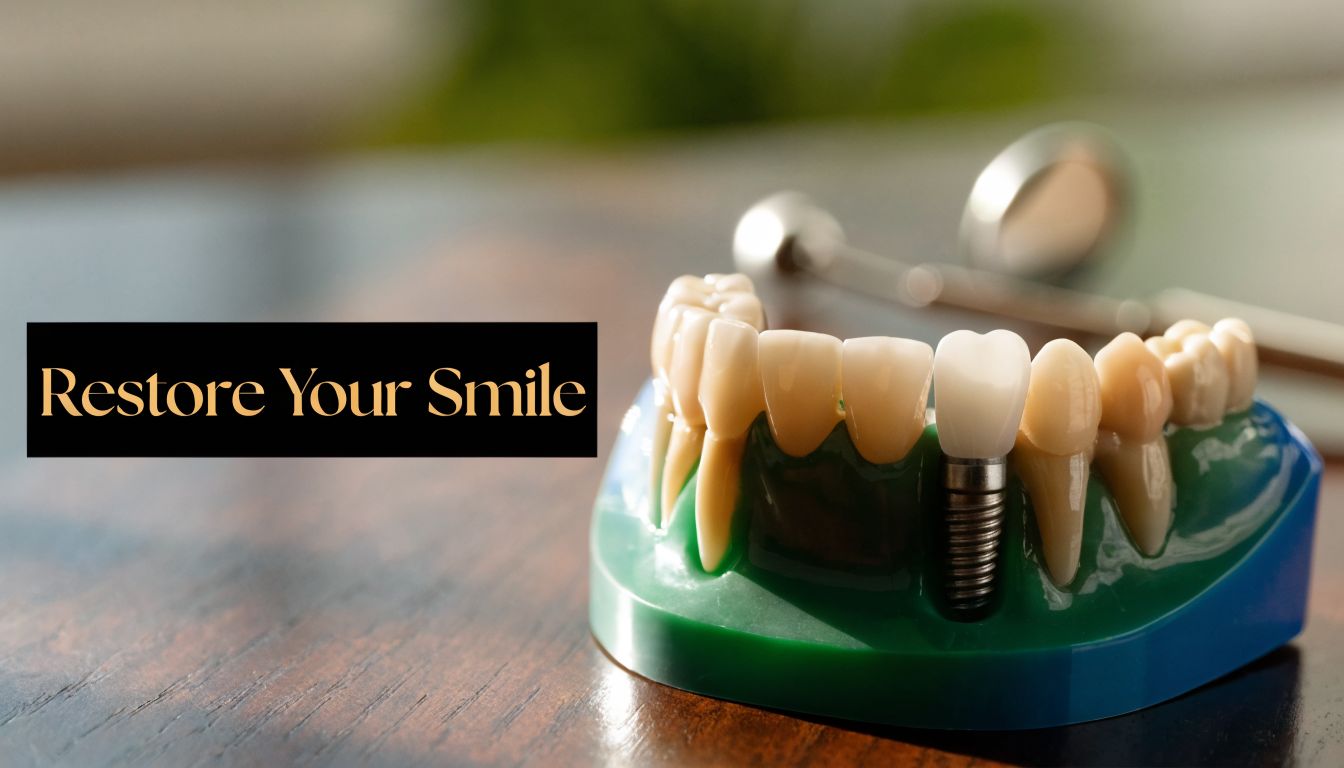
A front tooth implant replaces more than the part you see. It replaces the root under the gum as well. That matters in the smile zone because the root helps support the bone and soft tissue that frame your teeth, much like a tent pole helps hold the fabric in the right shape.

Why implants stand out
Patients usually ask me three practical questions. Will my smile look like me again? Will the teeth feel stable? Will this hold up well over time?
Implants tend to answer those questions better than removable options because they are anchored in the jaw, support the restoration from underneath, and avoid the shifting or bulk that many people notice with a removable appliance. For two front teeth, that underneath support is a big part of what makes the final result look believable instead of filling a space.
If you want a simple visual explanation of the mechanics, this guide on how dental implants work explains the process clearly.
Implants compared with traditional alternatives
A traditional bridge can restore missing front teeth, but it often depends on the neighboring teeth for support. A removable partial denture can also replace them, yet many patients tell me it feels less natural during meals, conversation, and daily life.
Implants offer several clear advantages for the front of the mouth:
- They replace the root, not just the crown. That helps maintain the bone and gum foundation that supports a natural-looking smile.
- They often protect healthy nearby teeth. Adjacent teeth usually do not need to be reshaped to hold the replacement.
- They feel more like your own teeth. A fixed solution often gives patients more confidence with speaking, smiling, and biting into food.
Clinical perspective: With two adjacent missing front teeth, success depends on rebuilding the hidden support under the gums as carefully as replacing the visible tooth structure.
That is one reason front tooth implants require such careful planning at Vienna Implant and Family Dentistry. We use CBCT imaging to see the bone in three dimensions before treatment begins, not just in a flat picture. That lets us measure available bone, check root position next to the space, and plan implant placement with the final appearance in mind. If you feel nervous about the procedure, sedation dentistry can make treatment feel much more manageable. Personalized aesthetic planning helps us shape the teeth and gums so the result fits your face, smile line, and surrounding teeth.
The reliability patients want to hear about
Long-term research supports implants as a dependable choice for replacing missing teeth. In a clinical review on implant outcomes, dental implant treatment for two adjacent missing teeth showed survival rates of 96.9% for implant-cantilever treatment and 97.6% for adjacent implants treatment over several years. The same review notes that overall implant procedures average about 97 to 98% globally, while traditional crowns show 50 to 80% success over a decade.
Numbers never replace a personal exam. Still, they help explain why implants are often considered the standard treatment for front teeth. When the case is planned carefully, the goal is not only to close a gap. It is to restore a smile that looks natural, feels secure, and lets you stop thinking about those missing teeth every day.
Your Treatment Options for Replacing Two Front Teeth
A lot of patients come to me expecting a simple answer. Two missing front teeth must mean two implants. Sometimes that is correct. Sometimes it is not.

For dental implants two front teeth cases, I look at the space between the neighboring roots, the thickness and height of the bone, the shape of the gums, your bite, and the size of the teeth we are replacing. At Vienna Implant and Family Dentistry, Dr. Chauhan uses CBCT imaging to measure that area in three dimensions. That helps us decide whether there is enough room and support for two separate implants or whether a different design would protect your smile better.
The two main approaches
Here is the practical comparison patients usually want first:
| Option | How it works | When it may fit | Main concern |
|---|---|---|---|
| Two individual implants | One implant supports each missing tooth | Common when bone and spacing allow proper placement | Needs enough room for both implants and healthy support around each one |
| One implant supporting two teeth | A single implant supports a two-tooth restoration | Limited cases with very favorable anatomy | Works for only a small group of patients and must be planned carefully |
When two implants are preferred
Two individual implants are the more common choice because each tooth gets its own support. That usually gives us better control over position, bite forces, and symmetry.
Patients often find this option easier to understand because it mirrors natural anatomy. Two crowns. Two implant roots underneath.
For front teeth, that matters. Small differences in angle or spacing can change how the final smile looks, so having separate support for each tooth can make planning more precise.
When one implant may support two front teeth
A single implant can sometimes support two adjacent front teeth, but only in selected cases. One implant can support two adjacent teeth in only 5-10% of cases, typically when the teeth are smaller and bone density is excellent based on this review of implant support options, which also notes that 93% of U.S. dental implants are made of titanium.
That option depends on the anatomy, not on convenience.
Here are the factors I study most closely:
- Tooth size: Smaller teeth may be better candidates for one implant supporting two crowns.
- Bone quality: The implant needs stable bone around it to handle the load.
- Spacing: The room available has to work for the implant position and the final restoration.
- Bite forces: If your bite puts too much pressure on the unsupported area, the design may not be a wise long-term choice.
A simple way to understand it is this: one implant for two teeth works a bit like a single pier holding up a small bridge. In the right setting, it can work well. In the wrong setting, too much force goes to one support.
What if there isn’t enough bone
If the bone in the area is too thin or too shallow, grafting may be recommended before implant placement. That is not unusual, especially in the front of the mouth where bone can shrink after a tooth is lost.
This is another point where CBCT planning matters. Dr. Chauhan can measure the site precisely, see where the neighboring roots sit, and judge whether we should rebuild the area first or move ahead with implant placement. If you feel anxious about surgery, sedation dentistry is also available to help the process feel calmer and more manageable.
Two people can be missing the same two front teeth and still need different solutions. The right plan is the one that gives you healthy support, a natural-looking result, and confidence when you smile.
Achieving a Natural Look The Art of Front Tooth Implants
Replacing front teeth is part surgery, part restorative dentistry, and part cosmetic design. That’s why these cases require more precision than replacing a molar you hardly ever see.

Why the esthetic zone changes everything
Your front teeth sit in the esthetic zone, the area people notice immediately when you smile. In this zone, placement has to be exact. A restoration can be healthy and strong but still look unnatural if the angle, gumline, or crown shape is slightly off.
That’s why planning starts before surgery. The dentist needs to study bone volume, root positions nearby, your smile line, and the direction the final crowns should emerge.
How CBCT and digital planning help
Front teeth implants require 3D imaging such as CBCT to evaluate bone and simulate placement according to this overview of front tooth implant planning. That type of imaging helps map the site in three dimensions instead of guessing from a flatter view.
In practical terms, that means the team can plan for:
- Implant angle so the final crown doesn’t look tipped or bulky
- Bone volume so the implant has proper support
- Root proximity so nearby teeth stay protected
- Smile harmony so the final teeth fit your face and bite
The gumline matters as much as the teeth
Many patients focus on the crowns, but the gums are what make a front tooth implant believable. If the gum contour looks uneven or collapsed, even a beautiful crown can stand out.
That same planning source notes that about 30-40% of front-tooth cases need bone grafting or soft tissue grafting to create a stable and esthetic foundation. It also states that after extraction, a temporary prosthesis is worn for 3-6 months to help maintain proper tissue contour while healing occurs.
The final result depends on shape, shade, translucency, and gum framing all working together. Front tooth implant success is never just about putting metal in bone.
In some cases, extra artistic touches are needed in the final restoration to blend the gum area naturally. That’s especially important when bone or tissue loss has changed the shape of the original site.
Your Step-by-Step Treatment Journey in Vienna
You look in the mirror before work and picture what it would feel like to smile again without covering your mouth. For many patients replacing two front teeth, the biggest relief comes from learning that the process follows a clear plan. You are not walking into guesswork. You are walking into a sequence.

Step 1 starts with mapping, not guessing
Your first visit is designed to answer two questions. Is the area ready for implants, and what will give you the most natural-looking result?
At Vienna Implant and Family Dentistry, we review your medical history, examine the missing-tooth area, study your bite, and use detailed imaging when needed. CBCT matters especially for front tooth cases because these teeth sit in the most visible part of your smile, where a small error in angle or depth can change how the final teeth look in photos, conversation, and close-up. Three-dimensional planning helps Dr. Chauhan evaluate the bone, nearby roots, and facial support before treatment begins, which reduces the kind of aesthetic guesswork that can happen in less precise setups.
If dental visits make you tense, we discuss sedation options early. That matters too. A calmer patient can hold still more comfortably during treatment, and that helps the team carry out a highly exact plan in a very visible area of the mouth.
Step 2 prepares the site for the result you want
Some patients are ready for implant placement right away. Others need the site prepared first so the implant and final crowns have the right support.
That preparation may include managing an extraction site, preserving bone, placing grafting material, or wearing a temporary tooth while the area heals into a better shape. Front teeth work like the frame of a window. If the frame is uneven, even beautiful glass will not look right. The same principle applies here. Dr. Chauhan plans the foundation first so the final teeth do not look bulky, flat, or out of place.
Step 3 places the implant with precision and comfort
Once the site is ready, the implant is placed into the jawbone according to the treatment plan created from your exam and imaging. This stage is usually more controlled than patients expect.
For nervous patients, sedation can make the appointment feel much more manageable. For front teeth, control matters because the implant position influences the future crown, gumline, and bite. The goal is not only to place an implant. The goal is to place it where the final smile can look believable and feel comfortable.
Step 4 protects your smile during healing
After placement, the implant bonds with the bone over time. During that healing phase, you may wear a temporary tooth or temporary restoration so you are not left with a visible space in the front of your smile.
Healing does not mean doing nothing. We monitor how the area is maturing and how the temporary is supporting appearance and function. If you want a broader overview of timing, this guide to the dental implant timeline explains how treatment is typically phased.
Step 5 finishes with the details people notice first
When healing is complete, the final restoration is attached. Careful planning ensures your new front teeth look right when you laugh, sound natural when you speak, and feel stable when you bite into food.
The final crowns are customized for details that make a visible difference:
- Shade and translucency: so the teeth match their neighbors instead of standing out
- Shape and edge position: so they fit your face and smile line
- Bite balance: so speech and chewing feel natural
- Gum support and emergence: so the teeth appear to come out of the tissue in a natural way
For many patients, this is the point when the focus shifts. It no longer feels like dental treatment. It feels like getting your smile back.
Understanding Costs and Making Your New Smile Affordable
Cost is often the reason people delay treatment, even when they know they want implants. That hesitation makes sense. Front tooth replacement is important, and you want to make a smart decision, not a rushed one.
What matters most is understanding that the final fee depends on the treatment design. Two separate implants, one implant supporting two crowns, a need for grafting, the type of temporary restoration, and the cosmetic detail required can all change the scope of care.
Why the treatment design affects the budget
A case with ideal bone and spacing is different from a case that needs tissue support first. A straightforward implant plan will not cost the same as one that requires additional preparation.
That’s also why online estimates can only go so far. They can’t tell you whether your case is suited to the more common two-implant approach or whether you might qualify for a more limited support option.
A lower-cost option may exist for the right patient
There is one point worth knowing early. A single centrally placed implant supporting two crowns is an emerging, cost-effective alternative that can provide a natural-looking result at a lower cost for some budget-conscious patients in Northern Virginia, according to this discussion of the single-implant two-crown option.
That does not make it the right option for everyone. It means candidacy matters, and cost discussions should happen after the anatomy is evaluated.
Financial takeaway: The least expensive treatment today isn’t always the most sensible treatment for your mouth. The right comparison is value, stability, appearance, and how much treatment you may need later.
How to plan the investment clearly
A good consultation should leave you with a written plan and a simple explanation of why one option fits better than another. If you’re trying to estimate the broader price factors involved, this guide on how much dental implants cost can help you understand what usually affects the total.
If you don’t have dental insurance, ask about payment options and in-house savings arrangements. Many patients assume implants are automatically out of reach until they see how treatment can be phased and planned.
Schedule Your Consultation at Vienna Implant and Family Dentistry
Replacing two missing front teeth can change much more than your smile. It can change how you speak, eat, laugh, and carry yourself day to day.
The key is planning the case correctly. Front teeth demand careful imaging, precise positioning, thoughtful temporary care, and a final restoration that blends with the rest of your smile. When those pieces come together, the result can feel remarkably natural.
If you’re in Vienna, VA or nearby Northern Virginia communities, the next step is simple. Schedule a consultation with Dr. Vikram Chauhan to learn which option fits your mouth, your goals, and your comfort level.
Bring your questions. Ask about bone support, temporary teeth, sedation options, appearance concerns, and whether one or two implants makes the most sense in your case. A consultation should give you clarity, not pressure.
If you're ready to talk through your options, you can contact the office through the Vienna Dental Experts website and request an appointment online.