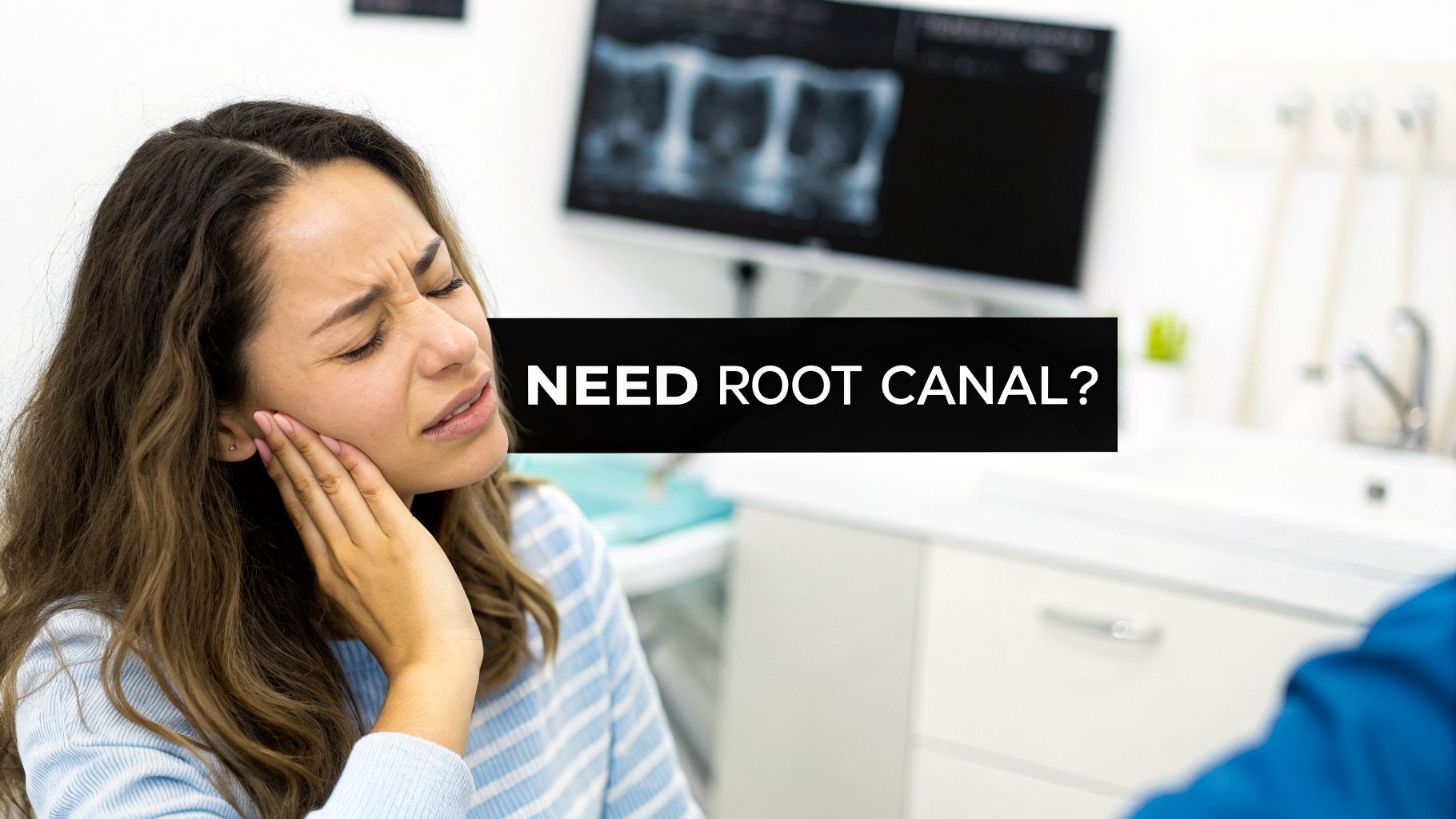
That deep, throbbing toothache is your body’s unmistakable alarm bell, but what is it actually trying to tell you? When you’re dealing with a persistent, severe pain that just won't quit, it might be a sign you need a root canal. This is often accompanied by other tell-tale symptoms, like lingering sensitivity, swollen gums, or even a tooth that’s started to look darker than its neighbors.
At Vienna Dental Implant & Family Dentistry, we understand that dental pain can be alarming. Our goal is to provide clear answers and compassionate care to our neighbors in Vienna, VA, and the surrounding Northern Virginia communities. We're here to help you get out of pain and back to your life with confidence.
Understanding the Signs You Might Need a Root Canal

When a tooth is in serious trouble, it doesn’t whisper—it shouts. Learning to recognize these signals is the first step toward getting relief. While the thought of a root canal can make anyone a bit nervous, understanding what’s happening inside your tooth can give you the confidence to seek the right care.
Dental pain should never be ignored. It's your body's way of signaling that something has gone wrong, and in many cases, it points to an infection or inflammation deep inside the tooth's pulp—the delicate core containing nerves and blood vessels. At Vienna Dental Implant & Family Dentistry, our first priority is always to get you comfortable and restore your oral health in a calm, judgment-free space. As a trusted local provider of family and restorative dentistry, we are committed to serving our Vienna, VA community.
Quick Guide to Root Canal Symptoms
Use this table to quickly identify the common symptoms that suggest an issue with the tooth's nerve. These are the signs we look for when determining if a root canal might be necessary.
| Symptom | What It Feels Like | Why It Happens | Urgency |
|---|---|---|---|
| Persistent Pain | A deep, throbbing ache that doesn't go away and may even wake you up at night. | The nerve inside the tooth is infected or inflamed and sending continuous pain signals. | High |
| Extreme Sensitivity | Sharp pain when eating or drinking something hot or cold that lingers for more than 30 seconds. | The nerve is damaged and overreacting to temperature changes. | High |
| Swollen Gums | A tender, swollen area on the gums near a specific tooth, sometimes resembling a pimple. | The infection has spread from the root tip into the surrounding bone and gum tissue. | High |
| Discolored Tooth | A tooth that has turned gray, dark brown, or black compared to neighboring teeth. | The internal pulp tissue has died, and the breakdown products are staining the tooth from the inside. | Medium |
| Pain on Pressure | Sharp pain when you bite down, chew, or even just tap on the tooth. | Inflammation has spread to the ligament surrounding the tooth root, making it tender. | High |
If you're experiencing any of these signs, especially constant pain or swelling, it's critical to see a dentist right away. These symptoms rarely resolve on their own and can worsen without treatment.
For those dealing with sudden discomfort, our guide on how to stop tooth pain fast offers helpful tips for temporary relief while you arrange to see a professional. Vienna Dental Implant & Family Dentistry offers same-day emergency appointments for our Vienna, VA, community, ensuring you get the swift, compassionate care you need.
What Really Causes an Infected Tooth
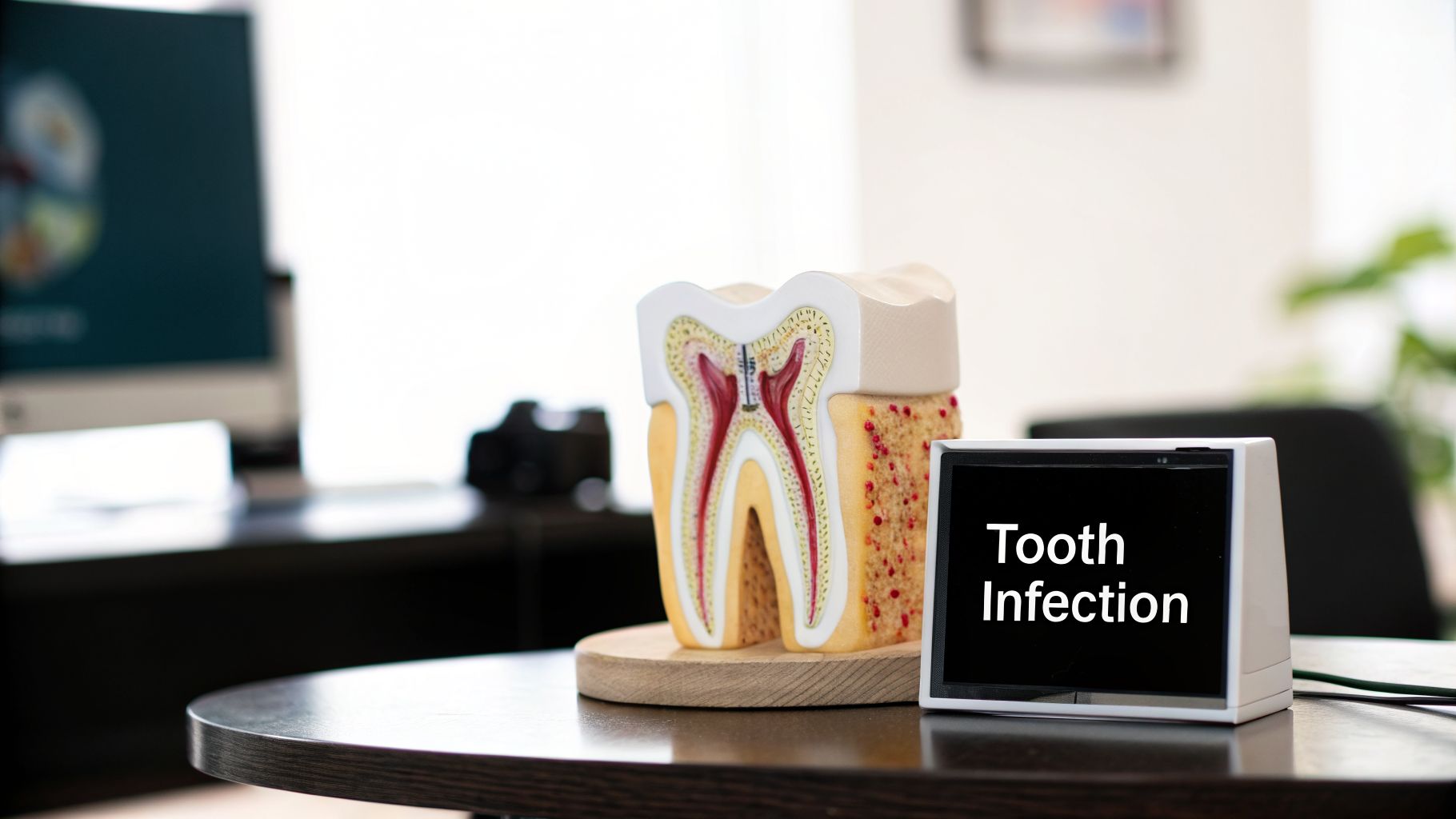
To understand why you might need a root canal, think of your tooth as having a living core. This inner chamber, called the pulp, is filled with nerves and blood vessels—it’s what keeps your tooth alive and able to feel temperature and pressure.
A tough outer shell of enamel and dentin acts as a shield, protecting this delicate pulp. But when that shield is breached, trouble starts. Bacteria, the tiny culprits behind nearly all dental problems, can find their way inside and begin to infect the living pulp tissue.
How Bacteria Get Inside Your Tooth
Bacteria are always looking for a way in. They don’t need a wide-open door; even a microscopic pathway can be enough to let them invade the pulp. The most common entry points we see are:
- Deep Cavities: An untreated cavity is like a slow-motion drill. Bacteria work their way deeper and deeper into the tooth until they finally reach the pulp chamber.
- Cracks or Chips: A fracture from an injury or biting down on something hard can create a tiny fissure, giving bacteria a direct highway to the tooth's core.
- Repeated Dental Work: A tooth that has had multiple fillings or other procedures over many years can become structurally weaker, making it more vulnerable to bacterial invasion.
- Trauma: A sudden blow to the face can damage the tooth’s blood supply. This can cause the pulp tissue to die and become a perfect breeding ground for bacteria, even if there’s no visible crack.
Once inside, these bacteria cause the pulp to become inflamed and infected. Your body’s immune system responds by sending in white blood cells to fight the invasion, which dramatically increases the pressure inside the tooth's rigid walls.
This internal pressure is precisely what causes that intense, throbbing pain of a toothache. Unlike a swollen muscle that can expand, the tooth has nowhere to go. The pressure builds up and presses directly on the nerve endings, creating a constant, severe ache that’s hard to escape.
Why the Pain Won't Disappear on Its Own
Once the pulp is infected, it can't heal itself. Without professional treatment, the infection will only get worse, eventually causing the pulp tissue to die. The bacteria can then move out through the tip of the tooth's root and spread into the jawbone, forming a painful pocket of pus called an abscess.
This is why "waiting it out" is never a good strategy for a severe toothache; the infection must be professionally removed. To learn more about what constitutes a true dental crisis, check out our guide on how to handle a tooth abscess emergency. Understanding the "why" behind the pain makes it clear why addressing these issues early at our Vienna, VA, practice is so critical for your long-term health.
How We Diagnose the Need for a Root Canal
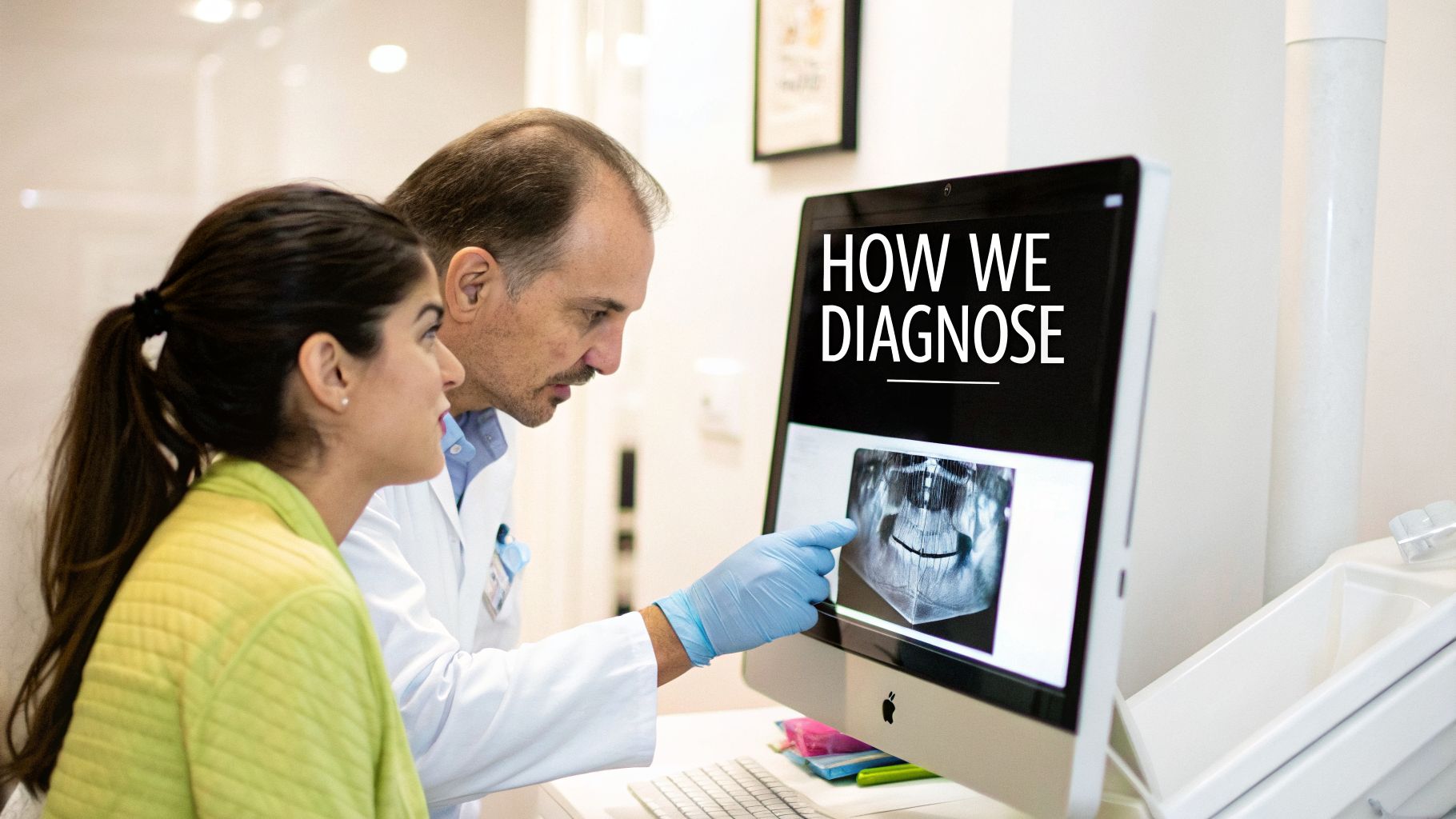
When you're struggling with tooth pain, the most important thing is getting clear answers so you can find relief. At Vienna Dental Implant & Family Dentistry, we know that visiting the dentist can be stressful. That’s why we’ve designed our diagnostic process to be as gentle, transparent, and straightforward as possible.
Figuring out what’s going on involves a few quick, painless steps. We start with a careful visual exam of the tooth and the gums around it, looking for the tell-tale signs of trouble—swelling, discoloration, or cracks that could explain your discomfort. This gives us important clues, but to really understand what's happening inside, we need to dig a little deeper.
Our Gentle Diagnostic Tests
To pinpoint the true source of your pain, we use a few simple, effective tests that tell us about the health of the tooth's nerve. These steps are quick and designed to be comfortable.
- The Cold Test: We gently touch the tooth with a small, cold cotton pellet. A healthy tooth feels the cold for a moment and then it's gone. If that sharp sensation lingers for more than 30 seconds, it’s a strong sign the pulp is inflamed and needs attention.
- The Percussion Test: We will very lightly tap on the tooth in question and its neighbors. If you feel pain or tenderness when tapping, it often means the infection has spread to the ligament surrounding the tooth’s root.
- The Bite Test: We might ask you to bite down on a small stick. A sharp jolt of pain when you apply pressure can help us find a crack or fracture that isn’t visible to the naked eye.
These tests help us confirm how to know if you need a root canal, but the most critical tool in our diagnostic kit is the digital X-ray. Modern X-rays give us a crystal-clear view of everything happening beneath your gumline.
Digital X-rays are absolutely essential. They let us see the entire tooth root and the surrounding bone with incredible detail. We can clearly spot an abscess—which shows up as a dark spot at the root tip—confirming an infection that has to be treated. This technology is fast, uses minimal radiation, and gives us the definitive answers we need to move forward.
With this complete picture, we can explain your diagnosis with confidence and partner with you to create a personalized treatment plan. Our commitment here in Vienna, VA, is to make sure you feel completely informed and comfortable with every single step of your care.
What to Expect During a Modern Root Canal
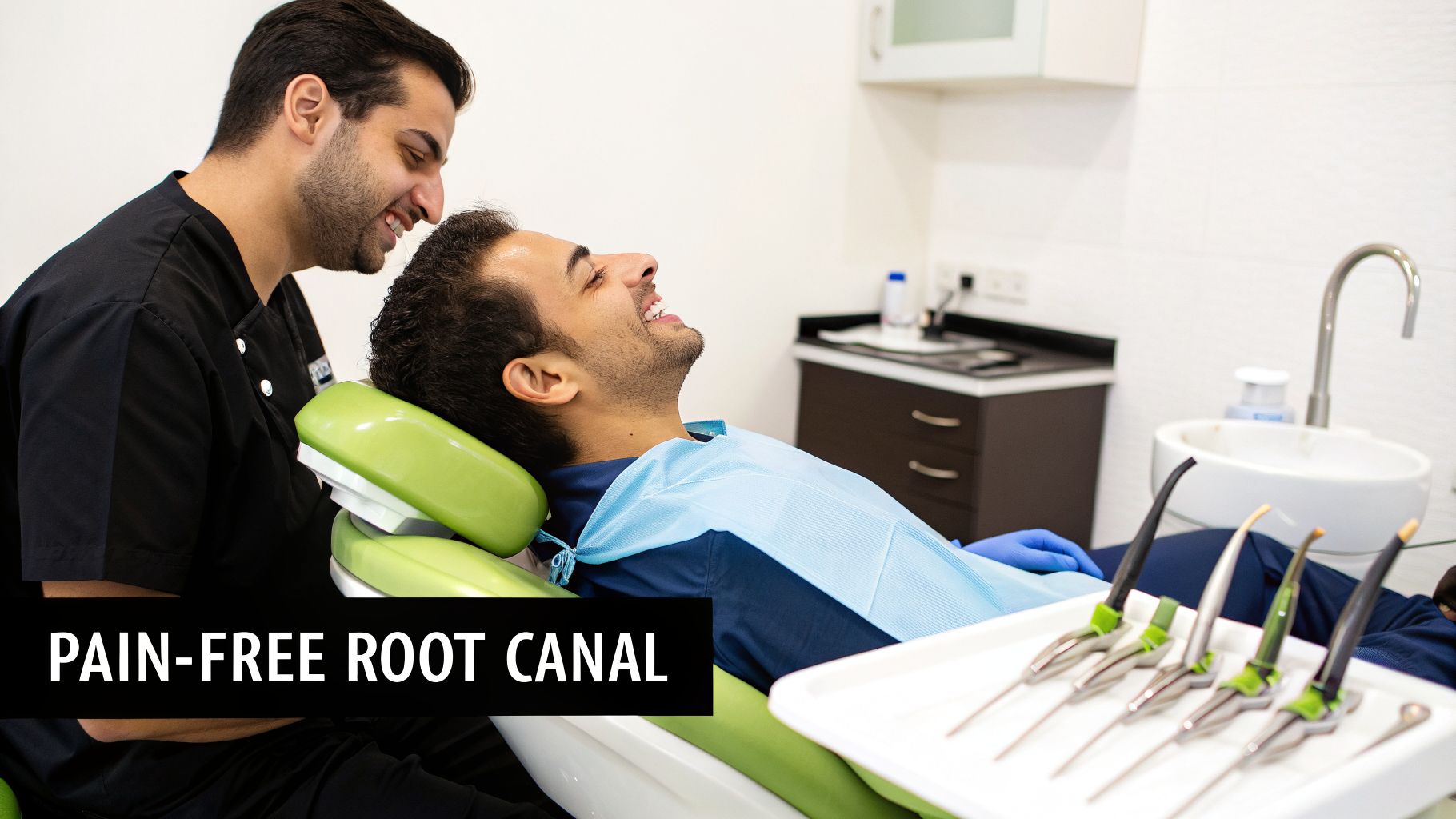
If the words "root canal" make you picture a scary, painful ordeal, it’s time for an update. The stories you may have heard from parents or grandparents simply don’t apply to today’s treatments. At Vienna Dental Implant & Family Dentistry, a modern root canal is a precise, pain-relieving procedure designed to save your natural tooth and end your discomfort for good.
Honestly, the entire process is often as comfortable as getting a routine dental filling. Our top priority is to eliminate your pain, not cause it, and today’s advanced techniques and powerful anesthetics make that a reality. Most of our patients are genuinely surprised by how calm and straightforward the experience is.
A Look at the Root Canal Process
Knowing what to expect can go a long way in easing any anxiety you might feel. We follow a meticulous, gentle process to ensure your comfort and a successful, lasting result.
- Ensuring Complete Numbness: First things first, we make absolutely certain the tooth and the entire surrounding area are completely numb. You will not feel any pain during the procedure.
- Removing the Source of Pain: We will then create a small opening to access the inside of your tooth, where he will gently remove the damaged and infected pulp tissue.
- Thoroughly Cleaning the Canals: Next, the inner canals of the tooth are carefully cleaned, disinfected, and shaped to prepare them for sealing.
- Sealing and Protecting the Tooth: Finally, the clean canals are filled with a biocompatible material and sealed tight to prevent any bacteria from getting back inside.
For our patients in Vienna, VA, who feel especially nervous about dental work, we proudly offer sedation dentistry. These options allow you to relax completely, ensuring a calm and stress-free visit while we work to restore your tooth's health.
This treatment isn't just a temporary patch; it's a reliable, long-term solution. Research shows that the success rates for modern root canals are incredibly high, with studies demonstrating 97% of treated teeth surviving after 10 years and an impressive 81% still stable after 20 years. You can read more about the long-term effectiveness of root canal therapy in this detailed 2023 study.
Protecting Your Tooth After Treatment
Once the root canal is complete, the tooth needs a permanent restoration to protect it from future damage and restore its full chewing strength. At our Vienna office, we can often handle this final step in a single appointment using our advanced same-day CEREC crown technology. This technology allows us to provide quality restorative dentistry quickly and efficiently.
This means you can leave our practice with a fully restored, functional, and natural-looking tooth—without the hassle of a temporary crown or a follow-up visit. By saving your natural tooth and protecting it properly, we help you maintain your smile for many years to come. For more details on what to expect after your appointment, be sure to check out our guide on root canal recovery.
Choosing Between a Root Canal and an Extraction
When you're facing a badly infected or damaged tooth, you come to a fork in the road. Do you save the tooth with a root canal, or do you have it removed entirely? At Vienna Dental Implant & Family Dentistry, we will almost always advocate for saving your natural tooth. A root canal is the gold standard for doing just that.
Keeping your own tooth provides powerful benefits that go well beyond just aesthetics. Your natural tooth root is a living part of your jaw, constantly stimulating the bone and keeping it strong. It also acts as a perfect placeholder, preventing neighboring teeth from shifting and throwing your bite out of alignment. Think of it as preserving the natural, intricate architecture of your mouth.
Why Saving Your Tooth Is the Preferred Choice
Pulling a painful tooth might seem like the quickest and easiest fix, but an extraction often just trades one problem for another. A new gap in your smile can set off a domino effect, leading to bite problems, trouble chewing your favorite foods, and even changes to your facial structure over time. An extraction is rarely the end of the story; it's usually just the beginning of needing a more complex replacement.
The goal of modern dentistry is to help you keep your natural teeth for a lifetime. A root canal isn't just about stopping pain—it's a procedure designed to rescue a tooth that would otherwise be lost, allowing you to maintain your smile’s function and appearance.
To get back to normal after an extraction, you’d need to look at options like a dental bridge or a dental implant. And while we are experts in advanced implant dentistry right here in Vienna, VA, we always tell our patients that nothing quite matches the form and function of your own natural tooth.
The Success and Longevity of Root Canals
Deciding to save your tooth is also a smart, evidence-backed investment in your long-term health. Modern root canal therapy is an incredibly reliable procedure with impressive success rates. In fact, extensive research shows that primary root canal treatments have an 86.02% success rate.
What does that mean for you? It means that over 90% of treated teeth last more than 10 years, and that number climbs to over 95% when the tooth is protected with a dental crown. These statistics, which you can read about in this comprehensive study, highlight just how valuable it is to save a natural tooth whenever possible.
As your partners in oral health, our team at Vienna Dental Implant & Family Dentistry will sit down with you and walk through all your options. We’ll give you the clear, honest guidance you need to choose the solution that best fits your health, your goals, and your life for years to come.
Your Partner for Comfortable Dental Care in Vienna
Making a big dental decision, especially when you’re in pain, can feel completely overwhelming. We get it. At Vienna Dental Implant & Family Dentistry, we’ve created a different kind of dental experience right here in our community—one that’s built on trust, comfort, and zero judgment. Your long-term health is our absolute priority, and we’re here to support you every step of the way.
We know that understanding your options is just as important as the treatment itself. That’s why we combine advanced clinical expertise with a genuine, patient-first approach. When you choose to save a tooth, you're making a smart investment in your health that will pay off for years to come.
Lasting Solutions for Your Smile
Modern root canals aren't something to fear; they are a reliable, long-term solution designed to save your natural tooth. When performed correctly and protected with a proper restoration like a crown, the success rates are remarkably high.
Long-term studies show an overall success rate of 87.8% at the tooth level, with an impressive 93% success even at the 10-year mark. Decades later, the procedure holds up incredibly well. Even after 37 years, the success rate remains a solid 81%. This data makes it clear: preserving a natural tooth is a dependable path to maintaining both your health and your smile. You can explore the findings yourself in this detailed research on long-term root canal success00572-8/fulltext).
Located at 112 Pleasant St. NW, Suite H, Vienna, VA 22180, our practice is where families from across Northern Virginia come for compassionate and expert care. We make it easy with convenient online scheduling and an in-house Smile Savings Plan to ensure treatment is always within reach.
If you’re experiencing any of the symptoms we've talked about, please don't wait for the pain to get worse. Schedule a consultation or an emergency appointment with our team at Vienna Dental Implant & Family Dentistry today. Let’s take the first step toward a healthy, pain-free smile that lasts.
Frequently Asked Questions About Root Canals
It's completely natural to have questions when you hear the words "root canal." At Vienna Dental Implant & Family Dentistry, we believe that honest, clear answers are the best way to put any concerns to rest.
We’ve put together some of the most common questions we hear from our patients right here in Vienna, VA. Our goal is to give you the information you need to feel confident and empowered about your dental care, replacing any anxiety with a sense of relief.
Is a Root Canal Really Painful?
This is the number one question we get, and the answer almost always surprises people: no, a modern root canal is not painful. In reality, the procedure is specifically designed to get you out of the severe pain caused by an infected tooth. The whole myth of the painful root canal comes from outdated techniques used decades ago.
Today, we use powerful local anesthetics to make sure the tooth and all the surrounding tissues are completely numb before we even begin. Most of our patients tell us the experience feels a lot like getting a routine filling. And for our Vienna patients who feel particularly nervous, we also offer gentle sedation dentistry to create a totally calm and stress-free appointment.
How Long Will Recovery Take?
Recovery after a root canal is typically very quick. You might notice some mild tenderness or sensitivity around the tooth for a few days, but this is easily managed with common over-the-counter pain relievers.
Most people are back to their normal routines, including work or school, the very next day. We'll send you home with a few simple aftercare instructions to follow, but you can expect a swift and comfortable healing process.
Why Can't I Just Take Antibiotics for a Tooth Infection?
While antibiotics can certainly help calm down the swelling and discomfort from a tooth abscess, they are not a permanent fix. Antibiotics travel through your bloodstream to fight infection, but the blood supply inside a dead or dying tooth is either severely compromised or gone completely. This means the medicine simply can't get to the source of the infection hiding deep inside your tooth.
Think of it this way: antibiotics can quiet down the infection in the surrounding bone and gums, but the bacteria hiding inside the tooth's canals remain untouched. Once you stop taking the antibiotics, the infection will inevitably return.
The only way to fully solve the problem and save your tooth is to physically remove the infected tissue from within. A root canal is the procedure that accomplishes this, cleaning and sealing the tooth to prevent that infection from ever coming back.