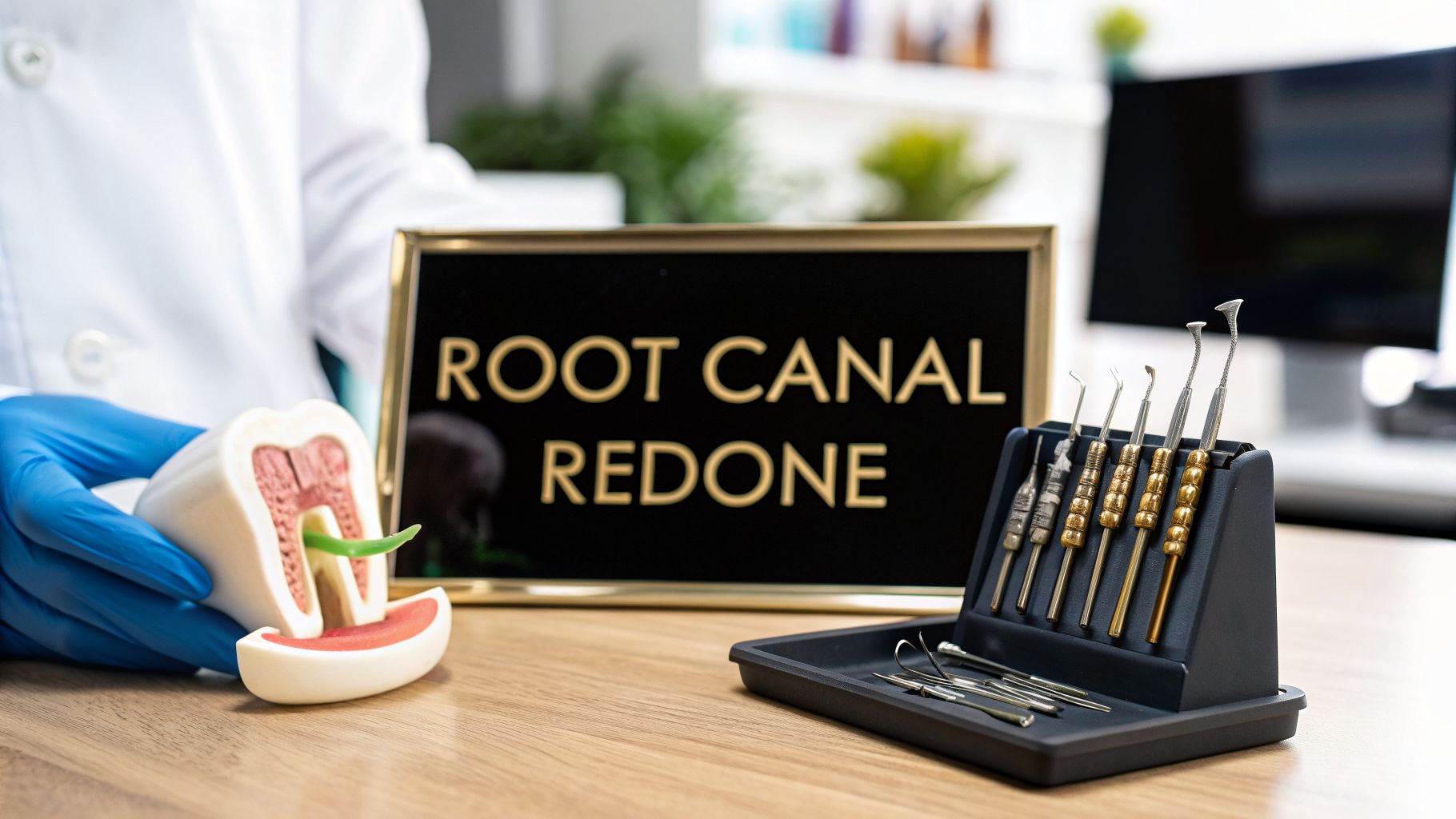
It can be incredibly frustrating to find out that a tooth you thought was fixed is now causing pain or problems again. If you've had a root canal in the past, the last thing you want is more trouble from that same tooth. The good news is that having a root canal redone is a common and highly successful procedure that can save your natural tooth and get you back to a healthy, comfortable smile.
At Vienna Dental Implant & Family Dentistry, we specialize in this exact kind of expert restorative dentistry, helping patients right here in Vienna, VA, and surrounding communities in Northern Virginia find lasting relief.
Understanding Why Your Root Canal Needs a Second Look
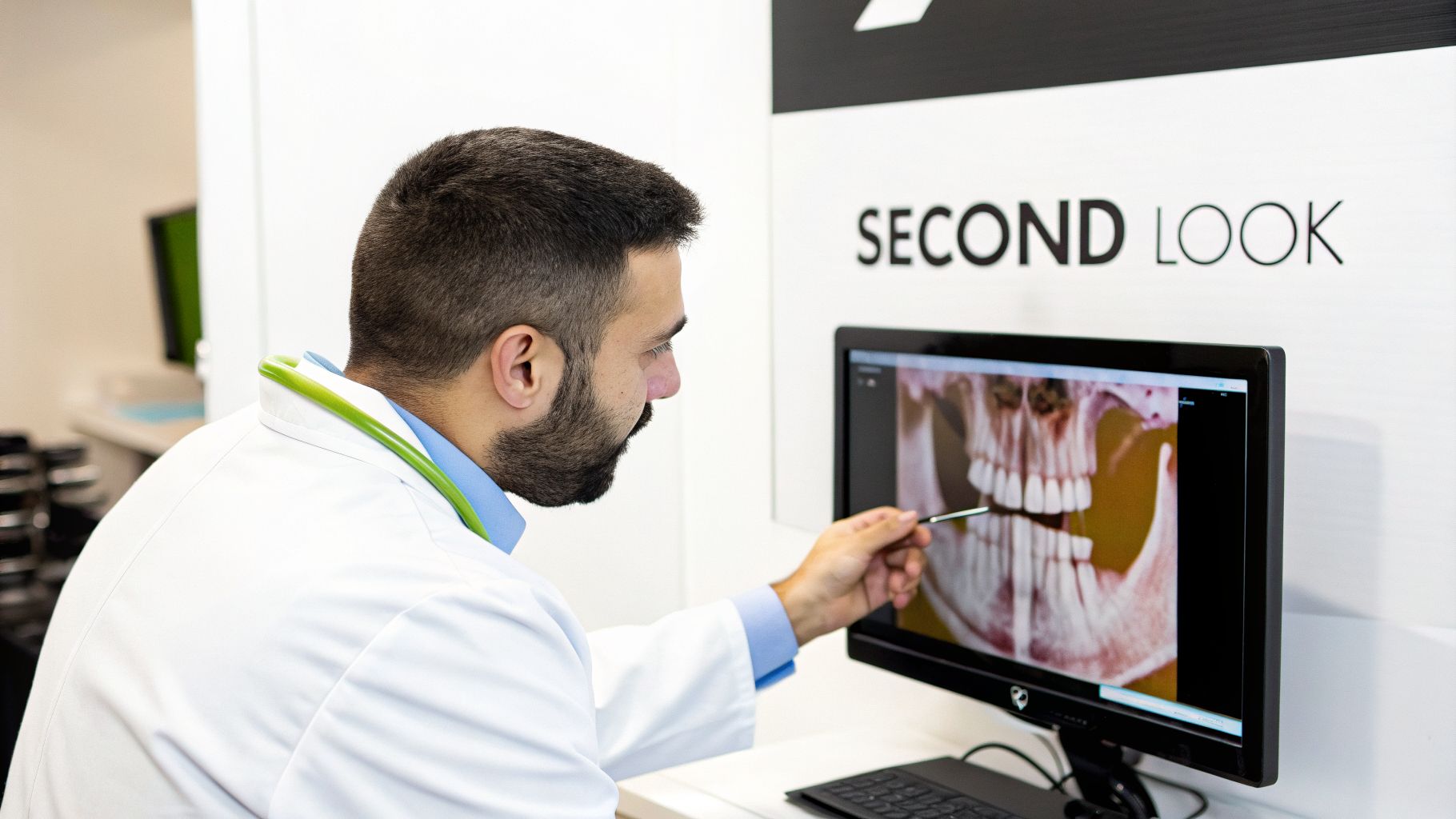
You went through the process, and your tooth was supposed to be fine. So why is it acting up now? It's a question we hear a lot at our Vienna, VA, practice, and the answer usually isn't about the original treatment being a "failure." It's more about new challenges arising that need to be addressed.
Think of an initial root canal like sealing off a room to keep it perfectly clean and protected. For the most part, that seal holds strong for years. But sometimes, a tiny, unseen crack can develop, or a new doorway can appear, allowing bacteria to get back inside and start a new infection.
Our goal is to figure out exactly how the bacteria got back in and to seal the tooth properly this time, giving you a clear path forward.
Complex Root Anatomy
One of the most common reasons a root canal needs to be redone is simply because of the tooth's incredibly complex structure. Just like no two fingerprints are the same, every tooth has a unique and intricate system of canals.
Some teeth have tiny, hidden accessory canals that branch off the main ones. These can be curved, narrow, or just plain hard to spot during the first procedure. If one of these microscopic passages was missed, any bacteria left inside can slowly multiply over the years, eventually leading to a new infection.
At Vienna Dental Implant & Family Dentistry, we use advanced 3D CBCT imaging to get a detailed map of your tooth’s entire root structure. This technology lets us see those complex, hidden canals that might have been missed during the original treatment, ensuring we can clean and seal them thoroughly.
New Decay or Trauma
A treated tooth is only as secure as the seal protecting it. Even a perfectly performed root canal can be compromised if the tooth's protective barrier is broken.
New decay developing around the crown or filling, for example, can create a microscopic pathway for bacteria to sneak back into the treated canals. A sudden injury that cracks the tooth or the restoration can do the same thing, instantly exposing the sterile interior to contamination.
- New Cavities: Decay can eat away at the tooth structure, creating leaks around the restoration.
- Cracked Crown: A damaged crown can no longer provide a complete seal against bacteria.
- Tooth Injury: Trauma can cause a fracture that exposes the treated root system to reinfection.
Issues with the Original Restoration
The final step of any root canal is placing a crown or filling to seal the tooth from the outside world. If that restoration breaks, leaks, or comes loose over time, it’s like leaving a window open. Bacteria from your mouth can seep back into the cleaned canals, undoing all the hard work of the original procedure.
This isn't an uncommon scenario in modern dentistry. Research analyzing worldwide data found that while 8.2% of all teeth globally have had a root canal, a staggering 55.7% of all adults have undergone at least one root canal. With so many people having this treatment, it makes sense that retreatments have become a key part of endodontic care. You can discover more insights about these findings on Wiley Online Library.
At Vienna Dental Implant & Family Dentistry, we see this not as a setback, but as a second chance to save your natural tooth for good. We're here to provide a clear, supportive path to relief, making sure you understand every step of the process.
Recognizing the Warning Signs of a Troubled Root Canal
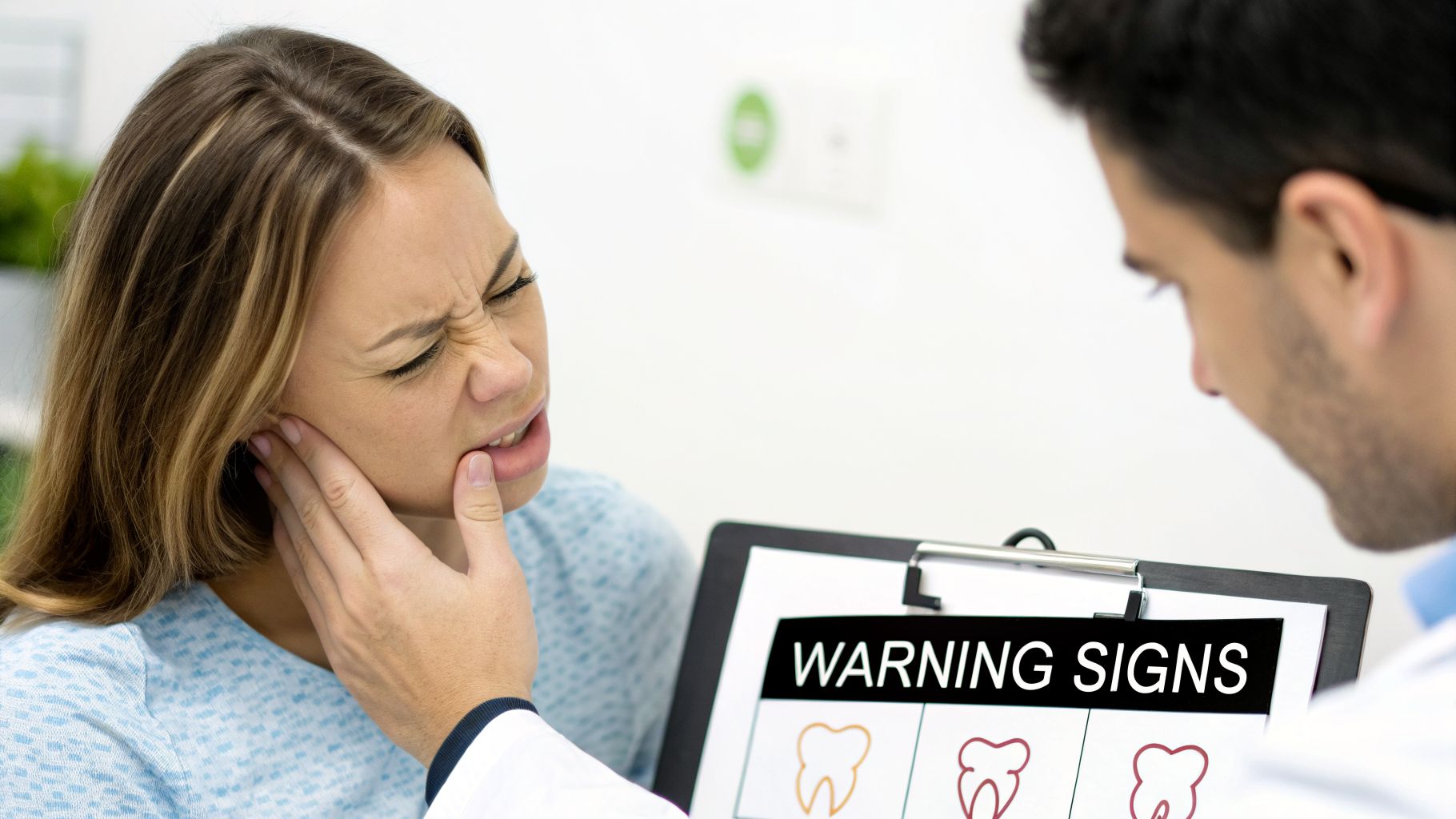
When a tooth that’s already had a root canal starts acting up, your body has a way of letting you know something isn’t quite right. These signals can be subtle at first, but paying attention to them is the best way to get ahead of a problem and protect the tooth long-term.
These symptoms don’t automatically mean disaster. Think of them as your body's early warning system, telling you it’s time for a professional to take a look. Ignoring them, however, can turn a small, fixable issue into a much bigger one. At Vienna Dental Implant & Family Dentistry, we want our Northern Virginia patients to feel empowered to recognize these signs without panic and seek a clear diagnosis.
Persistent or Recurring Pain
One of the most common signs that a root canal needs to be redone is pain. But this discomfort is usually different from the intense, throbbing toothache that sent you for the first root canal.
It might feel more like a dull, persistent ache that just lingers in the background. Or, it could be pain that comes and goes, flaring up for a few days before fading away, only to return weeks or even months later. This is often the tell-tale sign of a low-grade infection brewing deep inside or around the tooth’s root. Our guide on how to know if you need a root canal can offer some more background on these sensations.
Tenderness and Swelling
Another key indicator is tenderness, especially when you bite down or chew. If putting pressure on that tooth creates a sharp or tender feeling, it points to inflammation in the ligaments and bone surrounding the root tip—a classic sign of reinfection.
You may also spot a few other physical changes, such as:
- Gum Swelling: The gum tissue around the tooth might look red, puffy, or inflamed.
- A "Pimple" on the Gum: A small, pimple-like bump, known as a fistula or sinus tract, can pop up on the gums near the tooth. This is actually a drainage opening for an abscess and a clear sign of an active infection that needs immediate attention.
- Tenderness to Touch: The tooth itself or the gum area around it might feel sore if you press on it with your finger or tongue.
It's crucial to understand that a complete lack of pain doesn’t always mean all is well. Sometimes, a chronic infection can develop silently without causing any discomfort. This is precisely why regular check-ups at our Vienna, VA, practice are so important for your long-term oral health.
New Sensitivity to Temperature
A properly completed root canal removes the tooth’s nerve, so the tooth should no longer react to hot or cold. If you suddenly notice that tooth has become sensitive to your morning coffee or a glass of ice water, that’s a major red flag.
This new sensitivity might mean an undiscovered canal with living nerve tissue has become inflamed. It could also point to a new problem, like a tiny crack in the tooth that’s irritating the surrounding tissues. Either way, it’s a definite signal that the internal state of your tooth has changed and needs a professional evaluation. If you're experiencing any of these signs, scheduling a consultation is the best next step.
Exploring Your Treatment Options to Find Relief
Discovering that a tooth you thought was fixed is causing problems again can be incredibly frustrating. It’s natural to feel a bit discouraged, but the good news is that there are several excellent ways to address the issue, get you out of pain, and protect your long-term oral health. Our first goal at Vienna Dental Implant & Family Dentistry is to walk you through your choices, explaining everything clearly so you can feel confident about the path forward.
When a root canal fails, we generally look at three potential solutions. The right one for you will depend entirely on the specific condition of your tooth, your overall health, and what you want for your smile in the long run. We’ll break down each option without the confusing dental jargon.
Option 1: Nonsurgical Retreatment
In many cases, the most straightforward approach is simply to have the root canal redone. This procedure, called nonsurgical retreatment, is our go-to option when the goal is to save your natural tooth and its structure is still fundamentally strong.
Think of it like a skilled contractor renovating a room with a hidden plumbing leak. Instead of demolishing the house, they go back in, find the problem at its source, fix it properly, and seal everything up to be better than new. During a retreatment, your dentist will:
- Create a small opening to access the tooth's inner chamber.
- Carefully remove the original, now-contaminated filling material.
- Thoroughly clean, disinfect, and reshape the canals, paying close attention to any tiny, previously missed passageways where bacteria could be hiding.
- Refill and seal the canals with a fresh, sterile material.
- Protect the tooth with a temporary filling, which will later be replaced by a permanent new crown.
This is the most conservative path and almost always our first recommendation if we believe your natural tooth can be saved for the long haul.
Option 2: Apicoectomy (Root-End Surgery)
Sometimes, the infection isn’t inside the main part of the canal but is stubbornly located around the very tip of the tooth’s root. When that’s the case, and a standard retreatment can't reach it, a minor surgical procedure called an apicoectomy might be the perfect solution.
An apicoectomy is like tackling the problem from the outside in. Rather than working through the top of the tooth, your dentist makes a tiny incision in the gum tissue to access the infected root tip directly.
An apicoectomy allows us to remove the infected tip of the root and seal the end of the canal from the bottom up. It's a highly precise procedure that can save a tooth when a conventional root canal retreatment isn't enough.
We typically consider this option if a retreatment has already been tried without success, or if there’s a persistent cyst or blockage at the root tip that’s preventing us from cleaning it properly from the inside. It's another fantastic way to keep your natural tooth.
Option 3: Tooth Extraction and a Dental Implant
Our primary mission is always to save your natural teeth whenever possible. However, there are times when trying to save a tooth is no longer the most predictable or healthy choice. If the tooth has a severe crack, deep decay below the gumline, or has lost too much bone support, another root canal might just be putting a temporary patch on a failing situation.
In these instances, the best course of action is often to remove the problematic tooth and replace it with a dental implant. While that might sound like a major step, a modern dental implant is the gold standard for tooth replacement. It acts just like a natural tooth root, creating a rock-solid foundation for a new crown and preventing bone loss in your jaw. Opting for an implant gives you a durable, permanent solution that beautifully restores both function and appearance.
To help you see how these choices stack up, here’s a quick comparison of your three primary treatment options for a failed root canal.
Comparing Your Options for a Failed Root Canal
Making a decision can feel overwhelming, so this table breaks down the main goal, best-case scenario, and what to expect for each treatment pathway.
| Treatment Option | Main Goal | Best For | Procedure Type | Recovery Time |
|---|---|---|---|---|
| Nonsurgical Retreatment | To save the natural tooth by cleaning and resealing the canals. | Teeth with good structure but a new or recurring infection inside the canals. | Non-surgical, performed inside the tooth. | Minimal; similar to the original root canal. |
| Apicoectomy | To save the natural tooth by treating an infection at the root tip. | Teeth with persistent infection at the root's apex that can't be reached from inside. | Minor surgery at the gumline. | A few days of localized swelling and tenderness. |
| Extraction & Dental Implant | To replace a non-salvageable tooth with a permanent solution. | Severely cracked, decayed, or structurally compromised teeth. | Surgical placement of an implant post. | Varies; initial healing takes days, bone integration takes months. |
Ultimately, deciding between trying to save a tooth with a root canal redone and choosing a dental implant involves weighing the tooth’s prognosis against the long-term benefits and cost. If you’re considering replacement, you can learn more about how much do dental implants cost in our detailed guide. An informed choice always starts with a thorough evaluation, which is why we use advanced diagnostics at our Vienna, VA, office to recommend the most effective and lasting solution for your smile.
The Root Canal Retreatment Procedure Step by Step
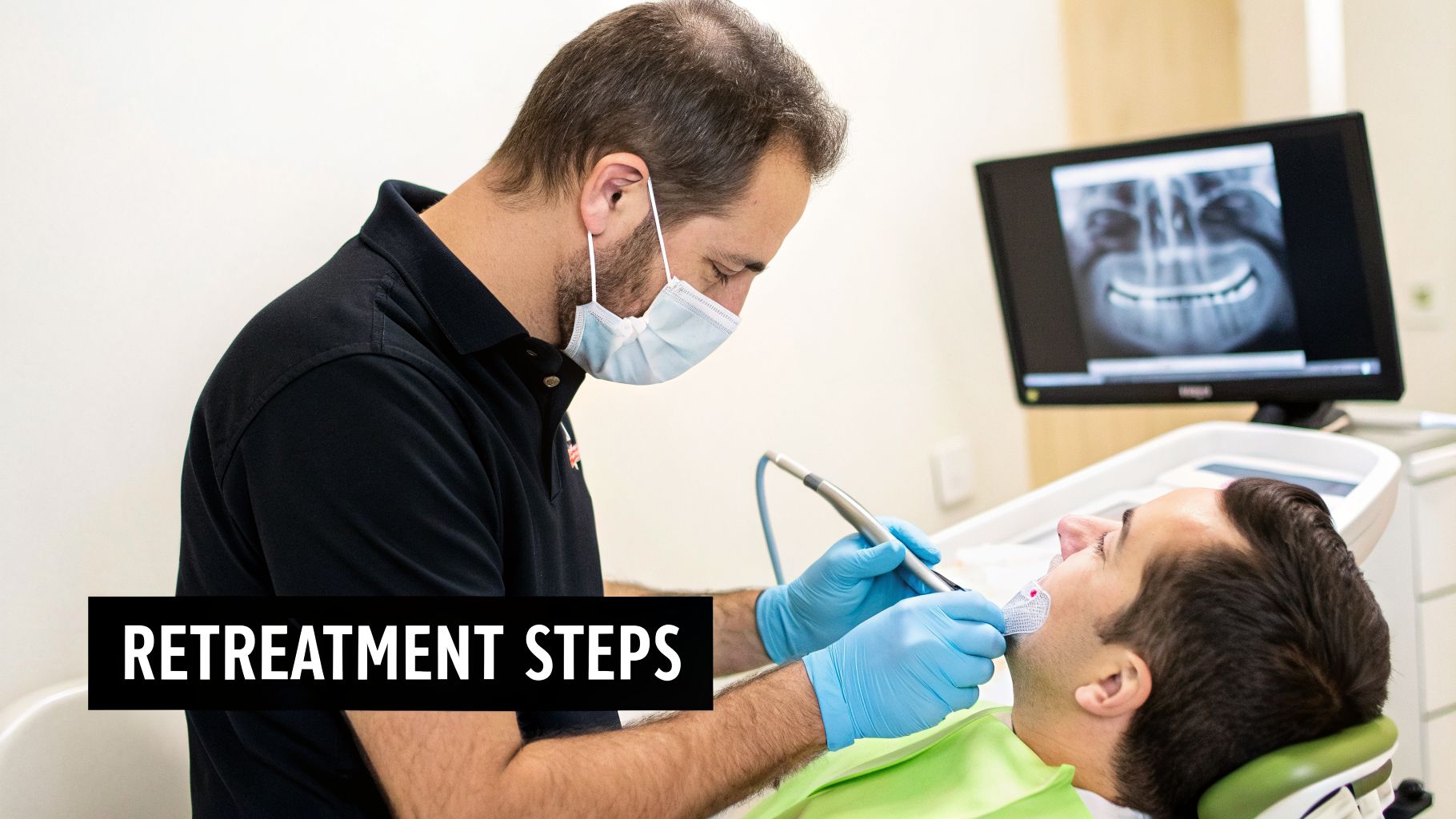
Walking into any dental procedure feels better when you know exactly what to expect. If a root canal redone is the recommended path for you, our mission at Vienna Dental Implant & Family Dentistry is to make the entire process clear, comfortable, and ultimately successful. The whole experience is built around your well-being, combining a gentle touch with modern technology to give your tooth a second chance.
You might be surprised to hear that the procedure itself is more straightforward than it sounds. In fact, many of our patients say it feels very similar to getting a standard dental filling. Here’s a look at what the journey entails when you visit our Vienna, VA office for your endodontic retreatment.
Step 1: Precision Diagnosis With 3D Imaging
Your path to healing starts with an incredibly precise diagnosis. Before we do anything else, we need a complete picture of what’s happening deep inside your tooth. That’s why we use state-of-the-art Cone Beam Computed Tomography (CBCT), which is like a high-definition, 3D X-ray of your tooth and jaw.
This detailed scan allows your dentist to see your tooth’s intricate root structure from every possible angle. It’s the key to uncovering hidden, narrow canals, pinpointing the exact source of the infection, and creating a meticulous plan for treatment. This advanced imaging is a non-negotiable first step; it ensures nothing is left to chance.
Step 2: Ensuring Your Complete Comfort
With a clear plan in place, our next priority is you. Your dentist will begin by carefully administering a local anesthetic to completely numb the tooth and the surrounding tissues. You can rest assured that you will not feel any pain during the procedure.
For our patients in the Vienna community who experience dental anxiety, we also offer a range of sedation dentistry options. These safe and proven methods help you achieve a state of deep relaxation, ensuring your appointment is a calm, comfortable, and stress-free experience from start to finish.
Step 3: Accessing and Cleaning the Canals
Once you are completely numb, your dentist will create a small, conservative opening in the crown of your tooth, just like in your initial root canal. This gives us direct access to the inner chamber and root canals.
The first task is to carefully remove the old filling material, known as gutta-percha, that was placed during the first procedure. Think of it as carefully cleaning out old, compromised sealant from a structure to prepare for a fresh, effective one.
Our gentle, meticulous approach is what makes retreatment successful. We use specialized instruments and high-powered magnification to find and remove all the previous filling material, giving us a clean slate to address the real source of the problem.
With the old material gone, the deep cleaning begins. Your dentist will use a series of tiny, flexible instruments to thoroughly clean, disinfect, and shape the inside of each canal. This critical step eliminates the bacteria and infected tissue that caused the failure, including from any tiny, previously missed passages.
Step 4: Resealing the Tooth for a Fresh Start
After the canals are immaculately clean and completely dry, they must be sealed again to lock out bacteria for good. A new, biocompatible, rubber-like material is used to fill the canals, creating a perfect seal from the tip of the root all the way to the top of the tooth.
To finish, a temporary filling is placed in the access opening to protect the tooth as it heals. You’ll return to our Vienna office a few weeks later for your permanent restoration—typically a durable and beautiful CEREC same-day crown. This final step is crucial, as it restores the tooth's full strength and protects your newly saved tooth from future damage for years to come.
Success Rates and Long-Term Outlook for Retreatment
When you’re told a root canal needs to be redone, it’s completely normal to feel a bit discouraged and ask: Is this really worth it? Facing another procedure can be daunting, but we want our patients in Vienna, VA, to have a clear, honest picture so they can feel confident in their decision to save their natural tooth.
The simple answer is that for most people, retreatment is an excellent and highly valuable choice. While the numbers are a little different from a first-time root canal, modern endodontic techniques give your tooth a very strong chance at a healthy, functional future.
Understanding the Success Rates
When a skilled practitioner performs endodontic retreatment, it has a very reliable track record. It’s a proven way to clear out a persistent infection and hold onto your natural tooth, which is always our number one goal at Vienna Dental Implant & Family Dentistry.
So, what do the numbers say? Recent, comprehensive studies show that the success rate for nonsurgical retreatment lands between 76.6% and 78%. While individual results can vary, these figures show that the vast majority of retreatments work exactly as intended. You can learn more about these findings on endodontic retreatment success rates from the American Association of Endodontists.
Looking at Long-Term Survival
Beyond just the initial success, what really matters is how long the tooth will last. How many years can you expect from a root canal redone? The research here is very encouraging.
The survival rate for retreated teeth after five years is approximately 89%. This means that nearly nine out of every ten teeth that go through this procedure are still healthy and working perfectly five years down the road.
This high survival rate is a testament to modern endodontic techniques. It confirms that choosing to redo a root canal isn’t just a short-term fix but a durable, long-term investment in your oral health.
Factors That Influence Success
Several key factors play a role in the final outcome, and choosing the right dental team is arguably the most important one. The success of a root canal retreatment is significantly higher when you partner with an experienced dentist who uses advanced diagnostic technology.
Here are the key factors that make a difference:
- Practitioner Skill: The expertise of the dentist in navigating complex restorative procedures is critical, especially when dealing with the intricate anatomy of a previously treated tooth.
- Advanced Technology: Our use of 3D CBCT imaging gives us an incredibly detailed view, ensuring we have a precise diagnosis and a meticulous treatment plan. Nothing is left to chance.
- Tooth Condition: The amount of healthy tooth structure that remains is an important factor in the long-term prognosis.
- Final Restoration: Protecting the tooth with a high-quality crown after treatment is absolutely essential to prevent future fractures or damage.
Here at our Vienna practice, we bring all these elements together to give your tooth the absolute best chance of success. We’re dedicated to providing care that not only resolves your immediate discomfort but also secures the health of your smile for years to come.
Your Trusted Partner for Complex Dental Care in Vienna, VA
When you're facing a complex dental issue like needing a root canal redone, making the right choice in a dental partner is the most important step you can take. Families throughout Vienna and Northern Virginia have come to rely on our practice, not just for routine check-ups, but for those critical moments when deep expertise, advanced technology, and genuine compassion truly matter.
At Vienna Dental Implant & Family Dentistry, our team has earned a reputation for navigating even the most challenging cases with a steady, reassuring hand. Our entire philosophy is built around providing you with clear, honest solutions and judgment-free care.
Advanced Technology Meets Compassionate Care
Successfully redoing a root canal isn’t just about skill—it demands absolute precision. We approach every complex case by starting with the best diagnostic tools available, including 3D CBCT scans. This technology creates a detailed, three-dimensional map of your tooth’s internal anatomy, allowing us to pinpoint the exact source of the failure before treatment even begins.
From that point on, our focus is entirely on your well-being. We know that the thought of another dental procedure can be stressful, which is why we proudly offer sedation dentistry. These safe and proven options help you feel completely calm and relaxed, letting us perform the detailed work needed while you rest comfortably.
Our commitment is to turn a potentially stressful situation into a positive and healing experience. By blending leading-edge technology with a gentle, patient-first approach, we take the fear out of complex dental work and deliver outcomes you can depend on.
The Right Solution for Your Long-Term Health
Our ultimate goal is to protect your oral health and give you a smile you feel great about for years to come. Whether that means meticulously working to save your natural tooth with retreatment or guiding you toward a durable, permanent dental implant, we will help you find the path that’s best for you.
We offer a full spectrum of restorative solutions right here under one roof, including:
- Expert Root Canal Retreatment: Giving your natural tooth a second chance at success.
- CEREC Same-Day Crowns: Providing a strong, beautiful, and immediate final restoration after treatment.
- Dental Implants: The gold standard for replacing a tooth when it cannot be saved.
You deserve a dental team that listens, understands your concerns, and partners with you to find a lasting solution. If you're struggling with a problematic tooth in Vienna, VA, or the surrounding communities, we invite you to schedule a consultation. Let's work together to restore your comfort and your confidence.
Your Questions About Root Canal Retreatment Answered
It's completely normal to have questions when you’re facing a complex dental procedure. We want every patient who walks into our Vienna office to feel knowledgeable and confident about their care, so we've put together answers to the questions we hear most often about getting a root canal redone.
How Do I Know if I Need a Root Canal Redone or a Dental Implant?
The decision between trying to save your natural tooth with retreatment and replacing it with a dental implant comes down to one critical factor: the health of the tooth itself. If your tooth's structure is still solid and the root is stable in the jawbone, retreatment is often the best path forward.
Right here in our Vienna office, your dentist uses advanced 3D imaging to get a crystal-clear look at the tooth’s root and the surrounding bone. If that imaging reveals a severe crack, decay that runs deep below the gumline, or significant bone loss, an extraction followed by a dental implant may offer a more predictable and durable solution for your long-term health. The only way to know for sure is to schedule a consultation for a thorough evaluation.
Is Getting a Root Canal Redone More Painful Than the First One?
Not at all. This is a very common worry, but just like the first procedure, retreatment is done under effective local anesthesia. You won’t feel any pain during the appointment. In fact, most of our patients tell us the experience feels a lot like getting a simple filling.
At Vienna Dental Implant & Family Dentistry, your comfort is our top priority. For even the most anxious patients, we offer safe and effective sedation dentistry to ensure you feel completely calm and at ease throughout your entire visit.
What Is the Recovery Like After Endodontic Retreatment?
Recovery from retreatment is typically fast and uncomplicated. You might have some mild tenderness or sensitivity in the area for a few days, but this is easily managed with over-the-counter pain medication like ibuprofen. For a more detailed look, you can learn more about root canal recovery in our dedicated guide.
We’ll send you home with simple aftercare instructions to follow. The vast majority of patients are back to their normal daily routines the very next day. A few weeks later, you'll come back so we can place your new, permanent crown, which fully protects your newly restored tooth.
How Much Does Root Canal Retreatment Cost in Vienna?
The cost of getting a root canal redone can vary, depending on which tooth needs work and how complex the situation is. Because it is a more intricate procedure that requires specialized techniques, retreatment usually costs more than an initial root canal.
After your examination, we will give you a completely transparent cost estimate so there are absolutely no surprises. We accept most major dental insurance plans and are always happy to help you understand and maximize your benefits. For patients who don't have dental insurance, we also offer our in-house Smile Savings Plan to help make exceptional care more affordable.