A dental emergency rarely happens at a convenient time. It’s often late at night, early before work, or in the middle of a family schedule that already feels packed. The pain gets your attention fast. Then the second worry arrives just as quickly: How am I supposed to pay for this without insurance?
That combination of pain, uncertainty, and cost keeps many people stuck. They try to wait it out, hope the swelling goes down, or head to the ER because it feels like the only option. If you’re searching for emergency dental care no insurance in Vienna, VA, the most important thing to know is that you do have options, and the right next step can protect both your health and your budget.
A Dental Emergency Strikes in Vienna What Do You Do Next
You wake up with throbbing pain in the back of your mouth. Cold water hurts. Biting hurts. Talking hurts. Maybe a filling came out, maybe a tooth cracked, or maybe the side of your face is starting to swell. You know you need help, but without insurance, it’s easy to freeze.
That reaction is common. Approximately 68.5 million adults in the U.S. lack dental insurance, and uninsured patients are 5.2 times more likely to visit emergency departments for dental problems according to CareQuest research on uninsured adults and emergency dental use. The same source notes that these ER visits cost the healthcare system over $2 billion annually, yet the ER usually provides only temporary relief, not definitive dental treatment.
Start with the right decision
If the problem is dental, a dental office is usually the place that can solve it. An emergency room can help when there are signs of a broader medical emergency, such as severe swelling that affects breathing, but it generally can’t treat the tooth itself.
For many people in Northern Virginia, the first useful step is simple:
- Call a dental office as soon as symptoms start. Earlier care often means simpler treatment.
- Describe the symptoms clearly. Pain, swelling, trauma, bleeding, and fever matter.
- Ask whether same-day evaluation is available. Urgent dental issues often can’t wait.
- Follow immediate first-aid instructions while you travel.
If you’re not sure how serious your situation is, this guide on what to do in a dental emergency can help you sort out the next move.
Practical rule: If you can point to a specific tooth, gum area, or dental injury, start by contacting a dentist. If you have trouble breathing, rapidly spreading swelling, or feel medically unstable, seek emergency medical care first.
The first goal is relief. The second is a plan.
Most uninsured patients aren’t just looking for pain relief. They’re trying to avoid making a costly mistake. That’s reasonable. The best emergency dental care no insurance approach is one that handles both problems at once: stop the pain, then choose the most efficient treatment path before the issue gets worse.
Immediate First Aid for Common Dental Emergencies
The first few minutes matter. Good first aid can lower pain, reduce damage, and improve the odds that a tooth can be saved.
Knocked-out tooth
This is the emergency where speed matters most.
For an avulsed tooth, gently rinsing it in milk and reimplanting it within 30 minutes can lead to a success rate of around 90%, while rinsing with water can damage root cells and increase failure risk by 70% according to this emergency dental trauma guide.
Do this right away:
- Pick the tooth up by the crown. Don’t touch the root.
- If it’s dirty, rinse gently with milk or saliva. Don’t scrub it.
- Try to place it back in the socket if you can do so gently.
- If that’s not possible, store it in milk and get to a dentist quickly.
Don’t do these things:
- Don’t rinse with water.
- Don’t wrap it in a dry tissue.
- Don’t delay to “see if it can wait.”
Severe toothache
A strong toothache usually means there’s inflammation, infection, a crack, or a deep cavity.
Helpful steps:
- Rinse with warm salt water. This can clear debris and soothe irritated tissue.
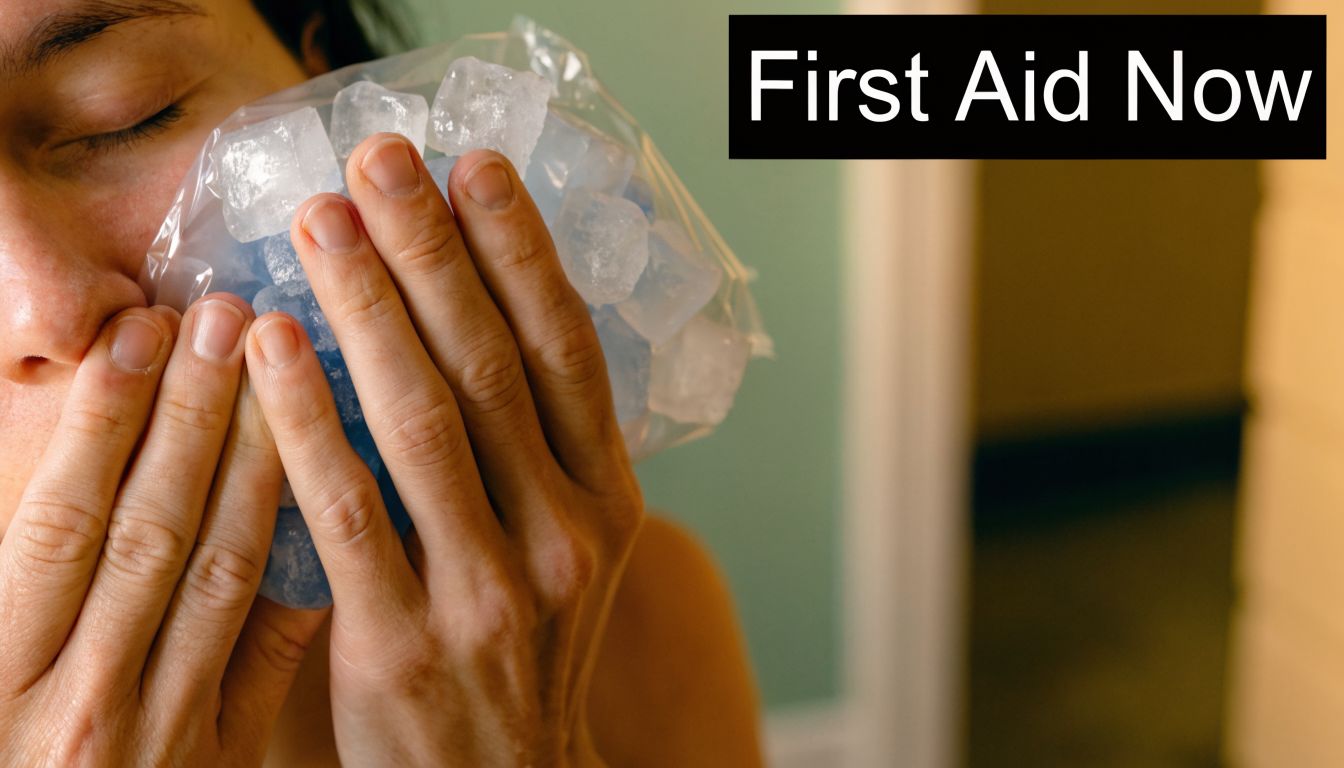
- Use a cold compress on the outside of the cheek. That may help with swelling.
- Keep the area clean. Food trapped between teeth can intensify pain.
- Call for urgent evaluation.
If you need quick at-home guidance while you wait to be seen, this article on how to stop tooth pain fast is a useful starting point.
Chipped or broken tooth
Not every broken tooth feels dramatic, but even a small fracture can become painful if the inner part of the tooth is exposed.
- Rinse gently with warm water.
- Save any broken pieces if you find them.
- Use a cold compress if there’s swelling.
- Avoid chewing on that side.
A rough edge can cut your tongue or cheek. If needed, cover the sharp area temporarily with sugar-free gum until you’re examined.
A broken tooth that “doesn’t hurt much yet” can still worsen quickly if the crack deepens.
Lost filling or crown
A lost filling or crown leaves the tooth vulnerable. Pressure, temperature, and air can all trigger pain.
- Keep the area clean.
- Avoid sticky or hard foods.
- If the crown came off and you have it, bring it with you.
- Don’t force it back into place.
Swelling or possible abscess
This is one of the most important emergencies to take seriously. If you have gum swelling, facial swelling, pus, foul taste, pain on biting, or fever, you may have an infection that needs prompt treatment.
- Rinse gently with warm salt water.
- Do not place aspirin on the gums.
- Do not try to drain the area yourself.
- Call a dentist immediately.
If swelling is spreading or you’re having trouble swallowing or breathing, seek emergency medical care first.
Emergency Dental Treatments Explained Costs and Procedures
During an emergency visit, the first job is to answer three practical questions fast. What is causing the pain, can the tooth be saved, and what treatment solves the problem at the lowest reasonable cost today.
That starts with an exam and, in many cases, X-rays. From there, treatment usually falls into one of a few categories. Some procedures buy time and reduce risk right away. Others are the definitive fix.
What the common treatments are for
| Treatment | What it does | When it’s commonly used |
|---|---|---|
| Emergency exam and X-rays | Identifies the source of pain, fracture, or infection | Toothache, swelling, trauma, lost crown or filling |
| Extraction | Removes a tooth that cannot be predictably repaired | Severe decay, major fracture, advanced infection |
| Root canal treatment | Removes infected nerve tissue and keeps the outer tooth structure | Deep decay, nerve pain, abscess in a tooth that is still restorable |
| Abscess drainage | Releases pressure and helps control a localized infection | Swelling, pus, painful gum or facial pressure |
| Bonding or smoothing | Covers or reshapes a chipped area so it is more comfortable and protected | Small fractures, rough edges, minor cosmetic damage |
| Temporary crown or protective restoration | Shields a weakened tooth until final treatment is completed | Broken tooth, lost large filling, damaged crown |
The right choice depends on the condition of the tooth, not just the pain level. I often see teeth that hurt badly but can still be saved, and teeth that feel dull or only mildly sore but have damage deep enough to make saving them unrealistic.
What uninsured patients usually want to know first
The usual question is simple. How much is this likely to cost without insurance?
Costs vary by office, the tooth involved, and how severe the problem has become before you are seen. In general, an emergency exam with X-rays is the least expensive starting point, while root canal treatment, crowns, and surgical extractions cost more because they take more time, materials, and follow-up care.
For uninsured patients, the most useful financial question is not only “What does this procedure cost?” It is “What happens to the total bill if I wait two weeks and the problem gets worse?” A small fracture may need smoothing or bonding today. If that crack reaches the nerve, the same tooth may later need a root canal, crown, or extraction.
That is the cost pattern I want patients to understand.
Why a dental office is usually the lower-cost place to start
Hospital emergency rooms are important for breathing problems, severe facial swelling, trauma involving the jaw, or symptoms that suggest a medical emergency. For tooth pain, a broken filling, a cracked tooth, or a localized dental infection, a dental office is usually the place that can treat the source of the problem.
The ADA’s emergency department referral program overview explains why. Many dental-related ER visits involve conditions such as tooth decay and abscesses, and referral programs that connect patients with a dental office have reduced repeat ER use and lowered hospital costs.
The practical issue is straightforward. An ER may help with pain control or antibiotics, but it usually does not place a filling, complete a root canal, recement a crown, or remove the infected tooth. You can leave with a large medical bill and still need a dental appointment.
The lower bill today is not always the lower cost overall. The better value is the treatment that stops the problem from spreading.
What to expect during the visit
A good emergency visit should feel clear, not rushed. You should be told what the diagnosis is, whether the tooth is saveable, what needs to be done today, and what can safely wait for a short time if budget is tight.
In many cases, there is more than one acceptable path. For example, a badly infected tooth might be treated with a root canal to keep it, or with an extraction if saving it would cost more than is realistic for you right now. Neither choice should be presented vaguely. You deserve a plain explanation of the trade-offs, including pain relief, long-term function, and expected cost.
That kind of conversation matters, especially if you are uninsured. It helps you make a decision based on both health and budget before a smaller emergency turns into a much more expensive one later.
The High Price of Postponing Emergency Dental Care
The most expensive dental emergency is often the one that gets delayed.

People usually postpone care for understandable reasons. They’re hoping the pain settles down. They’re worried the exam will lead to treatment they can’t afford. They’re trying to make it through the week. Unfortunately, teeth rarely reward waiting.
Now versus later
A useful way to think about emergency dental care no insurance is to compare today’s problem with the version of that problem you may face after a delay.
| If you act now | If you postpone |
|---|---|
| A painful tooth may be treated before damage spreads | The crack or decay can deepen, limiting options |
| Infection may be drained, controlled, or addressed earlier | Swelling can worsen and become harder to manage |
| A lost restoration may be replaced before the tooth weakens further | The unsupported tooth can break more severely |
| Costs may stay within a simpler urgent-care range | Treatment often becomes more involved and more expensive |
One verified comparison says it clearly: a $200 to $400 emergency extraction today can prevent the need for a $3,000+ root canal, crown, or dental implant later, as explained in this discussion of delayed treatment costs for uninsured patients.
Health costs are part of the bill too
Financial cost gets most of the attention, but delay has a physical cost. Pain interrupts sleep. Swelling affects eating and speaking. Infection can spread. A tooth that might have been restorable can become a tooth that needs removal.
That change affects more than a single appointment. It can lead to a gap in your bite, shifting teeth, or the need for a larger restorative plan later.
What usually doesn’t work
Patients often tell me they tried to “manage it” first. Sometimes that means avoiding one side while chewing. Sometimes it means rinses, clove oil, or hoping antibiotics from another setting will solve the problem. Those steps may reduce symptoms briefly, but they don’t repair a fracture, remove decay, or close a path for bacteria.
Waiting saves money only if the condition stays the same. Dental emergencies usually don’t.
How Uninsured Patients Can Afford Urgent Care in Vienna
A dental emergency without insurance often feels expensive before you even pick up the phone. In my experience, that uncertainty is what pushes people to wait. Waiting usually creates two bills instead of one. The first is the pain and disruption you deal with now. The second is the larger treatment cost that follows if the problem worsens.

Membership plans can make urgent care more predictable
For uninsured patients, the goal is usually not to find the cheapest possible visit. It is to get clear answers fast, control the immediate problem, and avoid paying for the same tooth twice.
A dental membership plan can help with that. These office-based plans often bundle preventive care and reduce fees on additional treatment. Some also include emergency exam benefits or same-day savings on urgent procedures. Terms vary by office, so ask for the written details before you commit.
What makes this useful is simple:
- The cost structure is clearer. You know whether the exam, X-rays, and treatment discounts are included.
- There is usually no insurance-style waiting period. If the office allows immediate use, you can apply the plan right away.
- You can make decisions faster. A defined discount often makes it easier to choose treatment before the condition gets worse.
How to compare your main options
Uninsured patients in Vienna usually look at three practical paths. Each one has a trade-off.
| Option | Best use | Main trade-off |
|---|---|---|
| Membership plan | Reducing exam and treatment costs through an office savings program | Upfront annual fee |
| Payment financing | Breaking a larger bill into monthly payments | Approval depends on credit and repayment terms |
| Delaying care | Postponing today’s expense | Higher risk of more pain, more visits, and a larger total bill |
If you are comparing offices, this guide to affordable dental care options in Vienna can help you sort through the local choices.
A practical financial roadmap
Start with the diagnosis. That is the step that protects your budget.
Here is the order I recommend for uninsured emergency patients:
- Schedule the exam first. You need to know whether you are dealing with decay, a fracture, an abscess, a failed restoration, or gum-related pain.
- Ask what must be done today. Pain relief, drainage, stabilization, or extraction may be the immediate priority.
- Ask what can safely wait. In some cases, definitive treatment can be staged over more than one visit.
- Review office savings options. If a membership plan or prompt-pay discount is available, apply it to the urgent visit first.
- Use financing for the part that cannot wait. Monthly payments can make sense once the treatment plan is specific.
- Choose the treatment that solves the problem. Temporary fixes can be appropriate, but repeated temporary care often costs more in the end.
Where uninsured patients lose money
The most expensive choice is often partial action. Patients sometimes pay for repeated short-term relief while avoiding the treatment that would stop the problem. That can mean multiple emergency visits, more missed work, more medication, and a tooth that becomes harder to save.
A clear plan matters more than a low sticker price.
One local option is Vienna Implant and Family Dentistry, which offers an in-house Smile Savings Plan, same-day emergency appointments, and transparent payment pathways for patients without insurance. For many people, that combination helps reduce the financial pressure enough to treat the problem before it turns into a larger health and cost issue.
Your Same-Day Emergency Visit at Our Vienna Dental Office
Callers often reach out while in pain, embarrassed, or overwhelmed. Some apologize for how long they waited. Others are worried they’ll be judged for not having insurance or for letting a small problem turn into a big one. That isn’t useful, and it isn’t how emergency care should feel.
What happens when you call
The first step is simple. You tell the team what’s going on. Tooth pain, swelling, trauma, a broken crown, a knocked-out tooth, or a lost filling all help us understand how urgent the situation is.
From there, the priority is getting you seen as quickly as possible and giving you clear instructions for the time before your appointment. If you’re anxious, say so. If cost is the biggest concern, say that too. Those details help shape the visit.
What the appointment usually looks like
At the visit, the focus is on three things:
- Find the source of the problem
- Relieve pain and stabilize the area
- Explain your treatment choices clearly
That may involve an exam, digital imaging, and a conversation about whether the tooth should be protected, restored, treated internally, or removed. If a crown is needed in the treatment plan, same-day CEREC technology can help in appropriate cases. If anxiety has kept you away from the dentist, sedation dentistry may be part of making urgent care manageable.
You do not need to arrive with a polished explanation. “My tooth hurts, I’m swelling, and I don’t have insurance” is enough to start.
What patients usually feel by the end
The biggest change is often relief through clarity. Even before full treatment is complete, people feel better when they know what the problem is, what can be done today, and what the financial path looks like.
A same-day emergency visit should replace panic with a plan.
Frequently Asked Questions About Emergency Dental Care
Will treatment hurt
Emergency treatment is designed to reduce pain, not add to it. The immediate goal is to get you comfortable and stabilize the problem. If you’re nervous, say that early so comfort options can be discussed.
I’m embarrassed by my teeth. Should I still come in
Yes. Dental emergencies happen to people who take excellent care of their teeth and people who’ve postponed care for years. The only useful question now is how to fix the problem safely.
Can you really see me the same day
Same-day emergency scheduling is often possible for urgent issues such as tooth pain, swelling, trauma, or a broken tooth. Call as early as you can.
Should I go to the ER instead
If you have trouble breathing, rapidly spreading swelling, or feel medically unstable, seek emergency medical care first. If the problem is centered on a tooth, filling, crown, or localized dental pain, a dental office is usually the more effective place to start.
What if I don’t have insurance
You can still get care. Ask about the exam, treatment priorities, payment options, and any membership savings plan that may apply.
If you need emergency dental care no insurance in Vienna, VA, call Vienna Implant and Family Dentistry at (703) 938-5555 or request a visit through online scheduling at Vienna Implant and Family Dentistry. If you’re in pain, don’t wait for it to become a bigger and more expensive problem.