It can be incredibly confusing and even disheartening to hear that a tooth needs to be extracted after you’ve already gone through a root canal to save it. While root canals have a very high success rate, sometimes new problems like a deep fracture or a hidden infection can crop up, making extraction the healthiest long-term choice. At Vienna Dental Implant & Family Dentistry, we want to help our Vienna, VA neighbors understand this situation and feel confident about the path forward.
When a Saved Tooth Still Needs to Be Removed
It’s a situation that leaves many of our patients in Vienna, VA feeling baffled. You invested your time and energy into a root canal to save a tooth, only to be told—sometimes years later—that it has to come out. This can feel like taking a step backward, but it’s often a necessary move forward for your overall oral health. At Vienna Dental Implant & Family Dentistry, we want you to feel informed and confident, not anxious.
Think of a root canal like a high-quality repair on the inside of a historic house. The procedure fixes the immediate problem by cleaning out infection and decay from the tooth’s inner canals, all to preserve the original structure. But just like that old house, if the foundation (your jawbone) or the walls (the tooth itself) suffer new, critical damage down the road, simply patching the interior isn’t enough anymore.
When a root-canaled tooth needs to be removed, it’s almost never because the original treatment failed. Instead, it’s because a new problem has developed that compromises the tooth’s stability for good.
Common Reasons for Extraction After a Root Canal
The decision for extracting a tooth after a root canal is never made lightly. Dr. Chauhan will only recommend it when the tooth can no longer be reliably saved. Here are the most common reasons why this might happen:
- Deep Vertical Fractures: A tiny crack can form that runs vertically down the root, far below the gumline where it can’t be seen. These fractures create a superhighway for bacteria to invade, leading to infection and bone loss. Unfortunately, a crack this severe simply cannot be repaired.
- Severe New Decay: Even a root-canaled tooth can get a new cavity, especially around the gumline or underneath an old crown or filling. If this new decay is extensive, it can eat away so much of the tooth that there isn't enough healthy structure left to support a new restoration.
- Advanced Periodontal Disease: Gum disease can completely destroy the bone and ligaments that anchor your tooth in place. Even if the inside of the tooth is perfectly fine after its root canal, severe bone loss around the outside can make the tooth loose and unsalvageable.
- Persistent or Recurrent Infection: In rare cases, a tooth might have an unusually complex root system with tiny, hidden side canals that weren't accessible during the first treatment. This can allow a low-grade infection to linger quietly for years before flaring up, sometimes without any obvious pain.
At Vienna Dental Implant & Family Dentistry, our first priority is always to preserve your natural teeth whenever we can. But when a tooth becomes a source of chronic infection or pain, removing it becomes the healthiest option to protect your surrounding teeth and jawbone.
If you find yourself in this situation, please know that modern dentistry offers fantastic solutions. Dr. Chauhan and our dedicated team specialize in gentle extractions and restorative options like state-of-the-art dental implants. We are here to provide clear, compassionate guidance for our neighbors in Vienna, VA, and the surrounding Northern Virginia communities.
Why Some Root Canals Fail Over Time
A root canal is a fantastic procedure, one of the best ways we have to save a natural tooth from infection. Most of the time, they are incredibly successful and last for many, many years. But it's important to know that a root-canaled tooth isn't invincible.
Over time, new problems can crop up that put the tooth's long-term health at risk. When that happens, extracting a tooth after a root canal sometimes becomes the smartest choice for your overall health. It's almost never that the original procedure "failed"—it's usually about new challenges appearing down the road.
At Vienna Dental Implant & Family Dentistry, we believe in giving you the real story so you can make confident decisions. Let's walk through why this happens.
The Most Common Culprits Behind Extraction
Several key issues can lead to the loss of a tooth that's had a root canal. These problems often develop quietly without obvious symptoms at first, which is exactly why your regular check-ups in our Vienna, VA office are so critical for catching things early.
Here are the most frequent reasons we see:
- Vertical Root Fractures: Think of these as deep, hidden cracks that run up and down the root of the tooth, well below the gumline. A vertical root fracture is like a tiny crack in a dam—it creates an entryway for bacteria to seep in, causing a stubborn infection and bone loss around the root. Unfortunately, these fractures are impossible to seal, making extraction the only way to stop the damage.
- Advanced Periodontal Disease: Your tooth needs a solid foundation of healthy gums and bone to survive. If progressive gum disease (periodontitis) destroys that vital support system, the tooth becomes unstable. Even a perfectly performed root canal can't save a tooth if the very bone holding it in place is gone.
- New, Aggressive Decay: Yes, a root-canaled tooth can still get a cavity. If new decay starts at the gumline or sneaks in under an old crown, it can silently eat away at what's left of your tooth. If the decay becomes too widespread, there simply isn't enough healthy tooth structure left to hold a new crown or filling, leaving extraction as the only option.
It's important to remember that a root-canaled tooth is no longer "alive" and won't send you the usual pain signals from new decay. This is why we rely so heavily on routine visits to spot these problems before they become severe.
Understanding the Timeline and Causes
Long-term studies give us valuable clues about why a root-canaled tooth might need to be extracted years later. This research helps us know what to watch for.
When a root canal eventually fails, the timing and reasons often follow a pattern. One study looking at long-term tooth survival found that among 87 extracted teeth, the average time from the root canal to the extraction was 14.1 years.
The main culprits? Vertical root fractures (33.3%) and periodontal disease progression (40.2%). This data, which you can read about in the full research on post-treatment tooth survival, confirms that the tooth's structure and the health of your gums are absolutely critical for long-term success.
This just reinforces that even after a great root canal, the journey isn't over. Consistent care and professional monitoring are your best defense. If you notice anything new or unusual—like a small pimple on your gum, tenderness when you chew, or a feeling that the tooth is loose—don't wait. Schedule a visit at our Vienna, VA practice so we can get to the bottom of it and protect your smile.
Your Gentle Tooth Extraction Procedure
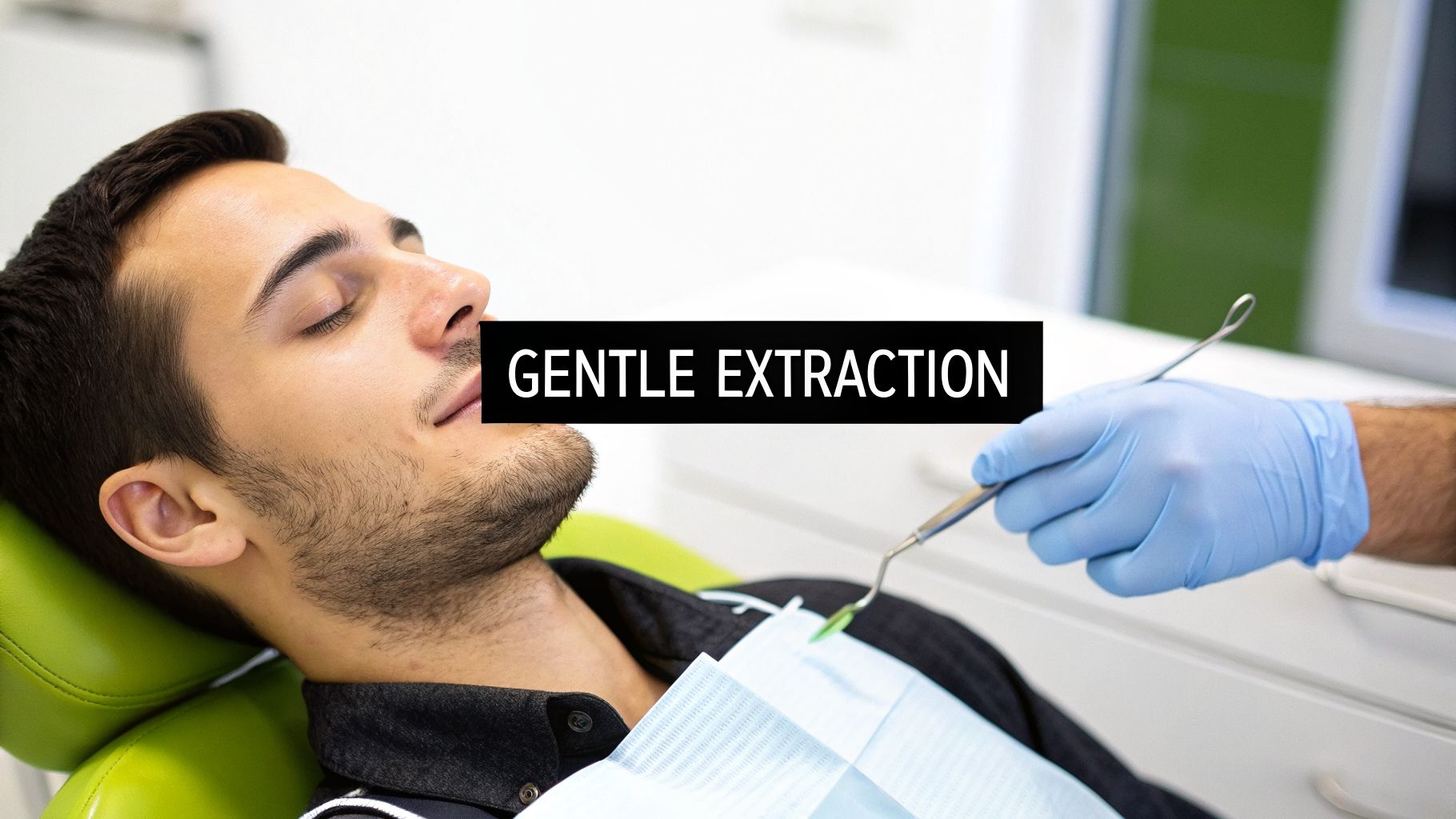
We understand that the thought of a tooth extraction can be nerve-wracking. That’s why at Vienna Dental Implant & Family Dentistry, our entire process for extracting a tooth after a root canal is designed around your comfort, safety, and peace of mind. We believe an informed patient is a calm patient, and we're committed to making your experience a positive one.
Your journey begins with a detailed and unhurried consultation with Dr. Chauhan. This isn't just a quick check-up; it's a comprehensive planning session where he uses advanced tools like digital X-rays to map out the most gentle and effective approach for removing the tooth.
A Painless and Stress-Free Process
Let's address the number one concern for most people: pain. We want to put your mind at ease. A modern tooth extraction should not be a painful experience. We use a powerful local anesthetic to completely numb the area, ensuring you won’t feel any pain—only some gentle pressure.
For those who feel particularly nervous about dental work, we proudly offer several sedation dentistry options. Our goal is to create a serene, completely stress-free environment for you.
To ensure every patient feels relaxed and in control, we offer a range of comfort options here at our Vienna, VA office.
Patient Comfort Options for Your Dental Procedure
| Option | Description | Best For |
|---|---|---|
| Local Anesthetic | A targeted numbing agent applied directly to the procedure site. | Every procedure, ensuring the immediate area is completely numb. |
| Oral Conscious Sedation | A prescribed pill taken before your appointment to induce a state of deep relaxation. | Patients with mild to moderate dental anxiety. You'll remain awake but feel completely at ease. |
| Nitrous Oxide ("Laughing Gas") | An inhaled gas that provides a feeling of calm and well-being. Its effects wear off quickly. | Patients who need to drive themselves home or prefer a lighter form of sedation. |
Choosing the right option ensures you can undergo your procedure without fear or discomfort.
Once you are completely numb and relaxed, Dr. Chauhan will skillfully remove the tooth. A tooth that has had a root canal can sometimes be more brittle, but his experience ensures the tooth is removed with minimal disturbance to the surrounding gums and bone.
After the tooth is out, he carefully cleans the empty socket. In many cases, we will place a bone graft at this time to preserve the jawbone's shape and density, creating an ideal foundation for a future dental implant. Our team will also give you clear, easy-to-follow initial care instructions to get your recovery off to a great start.
For more helpful tips, you can learn more about how to prepare for tooth extraction in our detailed guide.
What to Expect Immediately After
Following your procedure, our focus shifts to ensuring your recovery is as quick and comfortable as possible. We’ll arm you with simple steps to manage the first 24-48 hours.
- Managing Discomfort: Any post-procedure tenderness is usually mild and easily handled with over-the-counter pain relievers.
- Protecting the Site: You'll be asked to bite down gently on gauze to help a blood clot form in the socket. This clot is nature’s own bandage and is crucial for proper healing.
- Rest and Recovery: We strongly recommend taking it easy for the rest of the day. Rest allows your body to focus its energy on what matters most—healing.
From the moment you walk into our Vienna, VA office until you’re ready to head home, you are our top priority. Our entire team is here to support you, answer every question, and make sure you feel cared for and confident.
How a Crown Protects Your Root Canal Investment
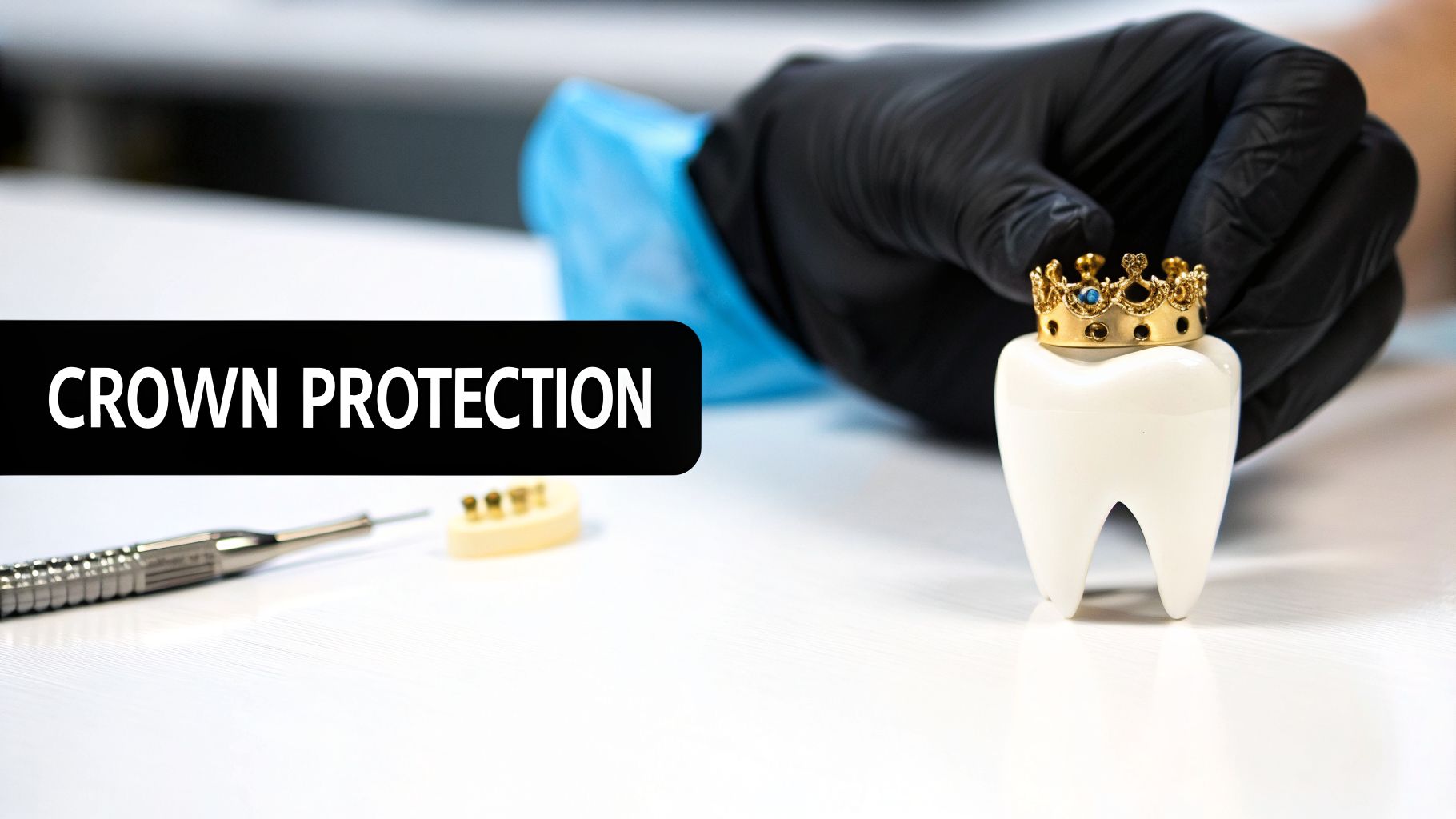
One of the biggest factors in preventing the need for extracting a tooth after a root canal isn't the procedure itself, but what happens right after: the final restoration. A root canal is fantastic at cleaning out infection and saving the tooth, but the process does leave it a bit more brittle than its neighbors. That’s because the inner pulp, which gives the tooth its hydration and vitality, has been removed.
Think of it like a tree branch that’s been hollowed out. It's still part of the tree, but it has lost its living core and is much more likely to snap under pressure. This is where a dental crown comes into play.
A crown acts like a helmet, completely covering the treated tooth. It takes the brunt of all the powerful chewing forces, shielding the vulnerable tooth structure underneath from fractures that could make an extraction unavoidable. In our Vienna, VA, practice, we’ve seen time and again that a high-quality crown is often the deciding factor in a tooth's long-term survival.
The Numbers Don't Lie
The difference in how long teeth last with and without a proper crown is staggering. Choosing the right restoration isn't just a minor detail; it’s arguably as important as the root canal itself for keeping the tooth working for years to come.
While root canal success rates are incredibly high—with 97% of teeth still functional after 10 years—that number depends heavily on the final restoration. Teeth that get both a filling and a crown can last for about 20 years. In contrast, teeth with just a filling or just a crown last closer to 11 years, and teeth left with no restoration survive only about 6.5 years on average. You can read more about these crucial long-term findings and see just how much restorative choices matter.
These statistics make it crystal clear why we almost always recommend a crown to safeguard your tooth.
A root canal saves the tooth; a crown protects that investment. Skipping the crown is like leaving a valuable asset uninsured against the most common risks.
The Advantage of Same-Day CEREC Crowns
No one wants to wait weeks for a lab-made crown, especially after you've already been through a root canal. During that waiting period with a temporary crown, your tooth is still at a higher risk of breaking.
At Vienna Dental Implant & Family Dentistry, we get rid of that waiting game with advanced CEREC (Chairside Economical Restoration of Esthetic Ceramics) technology.
- Digital Precision: We use a small scanner to create an exact 3D model of your tooth. No more goopy, uncomfortable impression trays.
- In-House Milling: Dr. Chauhan designs your custom crown right here in our Vienna office, and our on-site milling machine crafts it from a solid block of high-strength, tooth-colored ceramic in about an hour.
- One-Visit Convenience: You walk out of our office with your permanent, durable crown securely bonded to your tooth—all in the same visit. There's no temporary crown and no need for a second appointment.
This approach doesn't just save you time; it gives your newly treated tooth immediate, robust protection. This dramatically lowers the risk of a future fracture that might lead to extraction. Of course, taking care of your new crown is vital for its longevity. For expert advice, check out our guide on how to care for dental crowns. By choosing a CEREC crown, you're taking the single most effective step to ensure your tooth remains a healthy, functional part of your smile for the long haul.
Choosing the Best Way to Replace Your Tooth
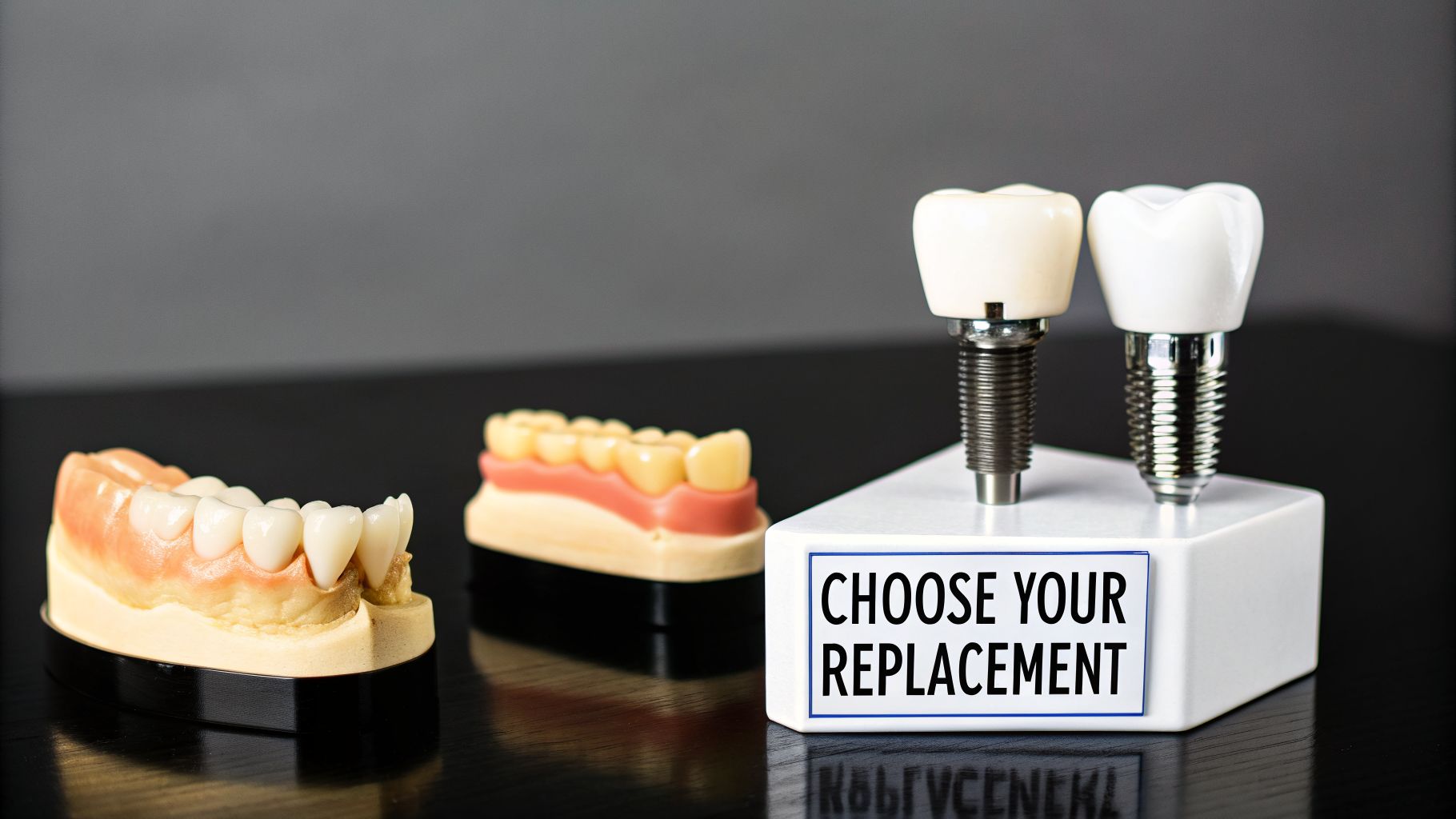
Once we've determined that extracting a tooth after a root canal is the necessary path forward, the conversation naturally shifts to what comes next. It’s tempting to think of the gap as just a cosmetic issue, but leaving it empty can kick off a chain reaction, impacting your bite, causing surrounding teeth to shift, and even affecting the health of your jawbone itself.
Thankfully, modern restorative dentistry has incredible solutions to fill that space, bringing back both the function of your bite and the beauty of your smile. At Vienna Dental Implant & Family Dentistry, our job is to walk you through the options, giving you clear, straightforward information so you can make a choice with complete confidence.
The Gold Standard: Dental Implants
When it comes to replacing a single missing tooth, dental implants are almost always the top recommendation. Why? Because an implant is the only solution that replaces the entire tooth structure—both the visible crown and the vital root beneath the gumline.
An implant starts with a small post made of biocompatible titanium, which is surgically placed into your jawbone right where the old root used to be. Over the next few months, your bone heals and fuses directly to the implant in a process called osseointegration. This creates an incredibly strong, stable foundation, essentially becoming a new, man-made tooth root.
Once that foundation is solid, Dr. Chauhan attaches a custom-made crown, perfectly matched to the shade and shape of your natural teeth. The result is a replacement that looks, feels, and chews just like the real thing. To see a full breakdown of the process, you can learn more about how dental implants work in our detailed guide.
A dental implant is the only tooth replacement that actively prevents jawbone loss. By mimicking a natural root, it stimulates the bone, keeping it strong and healthy for years to come.
Comparing Implants to Other Reliable Options
While implants are an outstanding choice, they aren't your only one. Traditional dental bridges and removable partial dentures are also reliable options, and understanding how they differ is key to making the best decision for your smile.
- Dental Implants: An implant is a standalone solution that doesn't rely on or affect your other teeth. It delivers the best stability, longevity, and bone preservation, making it the premier choice for long-term oral health. Dr. Chauhan's expertise in implant dentistry means our Vienna, VA patients receive the absolute highest standard of care.
- Dental Bridges: A traditional bridge literally "bridges" the gap left by a missing tooth. It uses a false tooth (called a pontic) held in place by crowns attached to the healthy teeth on either side. It’s an effective and aesthetic option, but it does require altering healthy teeth to place the supporting crowns.
- Removable Partial Dentures: This is an appliance with one or more false teeth that you can take in and out. It’s often a more affordable initial choice but offers less stability than an implant or bridge and can sometimes feel bulky or require adhesives.
Here’s a quick side-by-side look at these restorative solutions:
| Feature | Dental Implant | Dental Bridge | Partial Denture |
|---|---|---|---|
| Stability | Excellent (fused to bone) | Good (fixed to teeth) | Fair (removable) |
| Bone Health | Preserves jawbone | Does not prevent bone loss | Does not prevent bone loss |
| Impact on Other Teeth | None | Requires crowning healthy teeth | Can place stress on clasped teeth |
| Longevity | Potentially lifelong | 5-15 years | 5-10 years |
Ultimately, choosing the right replacement after an extraction is a personal decision. Dr. Chauhan and our team in Vienna, VA, are here to talk through each option with you, helping you land on the solution that restores your confidence and gets you back to smiling without a second thought.
Ready to Find a Solution in Vienna, VA?
We know that dealing with a failed root canal is incredibly frustrating. After you’ve already invested time and effort to save a tooth, facing another procedure can feel like a major setback. But you don't have to figure out the next steps by yourself. At Vienna Dental Implant & Family Dentistry, our entire team is here to offer expert guidance with a compassionate, personal touch.
Our practice is built on serving the Vienna community by providing everything you need under one roof, from gentle tooth extractions to beautiful, modern restorations. Your comfort is a top priority, and we offer a full range of sedation options to make sure your experience is as calm and pain-free as possible.
Your Next Step Toward a Healthy, Lasting Smile
Taking that first step can feel like the hardest part, but we make it simple. We invite you to schedule a one-on-one consultation with Dr. Vikram Chauhan. He will sit down with you, listen to your story, and conduct a thorough evaluation to get a clear picture of what’s going on.
This appointment is your time to get honest answers and explore all your options in a no-pressure environment. Together, you and Dr. Chauhan will map out a plan that not only gets your oral health back on track but also feels right for you, your budget, and your goals. Whether the best path forward is extracting a tooth after a root canal and replacing it with a durable dental implant or exploring another solution, we'll be by your side every step of the way.
Your peace of mind is everything. Here in our Vienna, VA practice, we blend advanced family and cosmetic dentistry with a genuinely personal approach, ensuring every patient feels heard, respected, and confident in their care.
Contact Us Today
Don't let dental pain or uncertainty dictate your life any longer. It's time to reclaim your confidence and build a foundation for long-term oral health. Our friendly team is ready to help you get started. We are proud to serve our neighbors in Vienna, VA, and the greater Northern Virginia area.
You can call our office directly to book your appointment. Our practice is conveniently located at:
112 Pleasant St. NW, Suite H
Vienna, VA 22180
For added convenience, you can also use our secure online portal to request a consultation. Let us help you take the first step toward the healthy, worry-free smile you deserve.
Frequently Asked Questions About Tooth Extraction After Root Canal
It's completely normal to have a lot of questions when facing an extraction, especially after you've already tried to save the tooth with a root canal. We've put together answers to some of the most common concerns we hear from our patients at Vienna Dental Implant & Family Dentistry.
If you don't see your question answered here, please reach out to our Vienna office. We’re always here to provide the personalized information you need.
Is It Painful to Have a Tooth Extracted After a Root Canal?
We understand that the number one concern for most people is pain. Let us put your mind at ease: the extraction procedure itself should not be painful. We use a powerful local anesthetic to make sure the entire area is completely numb before we begin. The only thing you should feel is some gentle pressure.
For patients who feel anxious about the procedure, we also offer several sedation dentistry options. Your comfort and peace of mind are our top priorities, and we'll do everything we can to ensure your experience is as calm and stress-free as possible.
How Long Does It Take to Recover From This Type of Extraction?
The initial healing phase is surprisingly quick, usually lasting just a few days. Most people are able to get back to their normal routines very quickly.
Full healing, where the bone completely regenerates in the socket, takes a bit longer—typically a few weeks.
Important Takeaway: The single most important factor for a smooth and speedy recovery is following your post-op instructions carefully. This means sticking to soft foods for a bit, avoiding straws, and keeping the site clean as directed.
We'll send you home with detailed aftercare instructions to guide you through the healing process, and our team is just a phone call away if you have any questions.
Do I Have to Replace the Tooth After It Is Extracted?
While it’s not technically mandatory, we highly recommend that you replace the extracted tooth. When you leave a gap in your smile, the surrounding teeth naturally start to shift and tilt into the empty space.
This can throw off your bite, make chewing more difficult, and lead to bone loss in your jaw over time. We will sit down with you to discuss all your replacement options, from dental implants to bridges, to find the right solution.
How Soon After Extraction Can I Get a Dental Implant?
The timeline for getting an implant really depends on your unique situation. For some patients, we can place a dental implant on the very same day as the extraction. This is called an immediate implant.
In other cases, it’s better to let the site heal first. We might even place a bone graft to build up a strong foundation for a future implant. Dr. Chauhan will carefully evaluate your oral health and map out a personalized treatment plan that ensures the best possible outcome.
Unfortunately, extraction is a more common outcome than many realize. A large five-year study revealed that when complications arose after a root canal, extraction occurred 61.5% of the time. Overall, about 12.1% of treated teeth experienced some adverse event within five years, with the vast majority of those—94.9%—being extracted. To explore these findings further, you can read the full research on tooth survival rates. This data highlights why having a clear plan for what comes next is so important.